There are plenty of hardware step sequencers out there. But now Arturia has a compact entry friendly to keyboardists. This isn’t about dialing up melodies with knobs. It assumes you actually know how to find melodies on some keys.
Clearly building on the success of the BeatStep Pro sequencer hardware, Arturia’s Keystep is a keyboard with both step sequencer and arpeggiator modes. And Arturia has given CDM an exclusive first peek, to share with you.
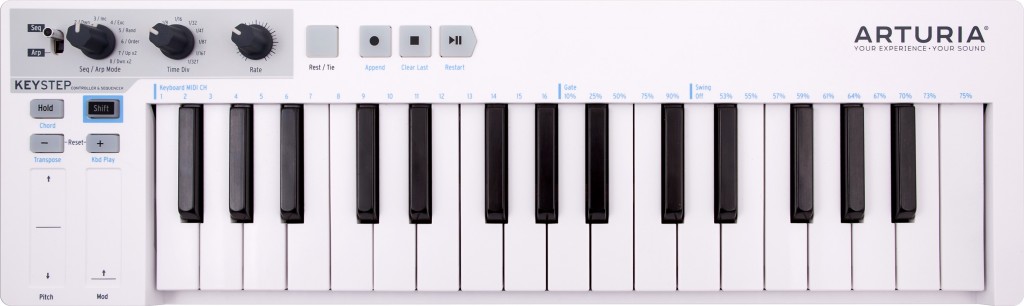
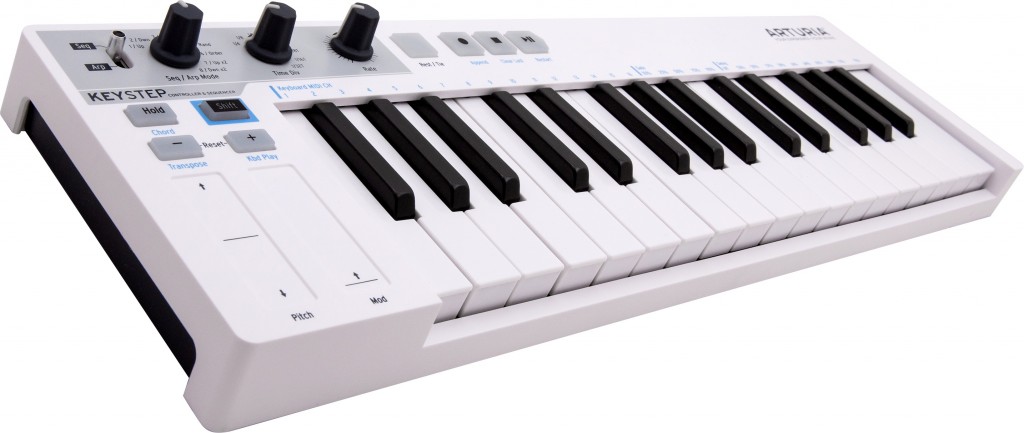
First, the keyboard itself. It’s a 32-note slim keybed of Arturia’s own making. That keeps the overall body tiny – so this is clearly a mobile keyboard. There’a also built-in (channel) aftertouch.
Pitch bend and mod are provided via capacitive touch strips. So with that combined with aftertouch, you have some control over parameters, though you might still miss the encoders available on the BeatStep Pro.
In a piano-friendly touch, there’s both a pedal input and a HOLD button. “HOLD” isn’t just the equivalent of ‘tie’ – it actually lets you add a sustain pedal by touching a button. In arpeggiator mode, it latches the arpeggiator.
And there are dedicated octave shift keys.
There are two modes.
Step sequencer mode has 8 memory slots.
Each step sequence is 64 steps long, so this isn’t just a one-bar affair. And while ‘step sequence’ is often associated with a mono melody line, here each “step” can contain 8 notes per step, with 8 voices.
You can either tap record and record in real time, or add notes one step at a time. (There’s a dedicated REST/TIE button.) In real-time mode, you can also overdub as you record.
Additionally, you can set and play chords triggering a single note (one finger keyboardist style).
Arpeggiator mode has 8 pattern styles: Up, down, Inclusive, Exclusive, Random, Double up, Double down, Note Order.
Whether you’re using the arpeggiator or the step sequencer, you can adjust Gate and Swing settings (to some fixed values), and time division up to 1/16 notes as duplets or triplets.
You can also extend or shorten a sequence length.
A really cool feature you might easily miss is Keyboard Play Mode. This lets you leave the sequencer playing, but also play the keyboard. You can even set the sequencer and keyboard to separate channels so that each plays a different instrument. (Since there’s only one CV out, that’s always the sequencer.)

I/O:
- Micro USB. (both for USB MIDI with a computer or via adapter iOS device, and for optionalUSB power)
- DC external power.
- Gate and CV outputs for analog gear. (10V gate, 1 volt/octave OR volt->Hz modes on CV out.)
- Mod output, too — assigned to aftertouch, mod strip, or velocity.
- Sync over USB, MIDI, or the Clock port (DIN sync) – or use internal clock.
- MIDI in and out (via the ever-more-popular minijack port).
- DIN sync (for both arp and sequencer mode) gives you 1PPS, 2PPQ, 24PPQ DIN and 48PPQ sync with hardware.
Like the BeatStep Pro, the Keystep (with external power) runs standalone, too, so you can use it with hardware instruments and leave the computer at home.
It looks like another huge hit from Arturia to me. There’s still clearly lots of room for the BeatStep Pro. Those pads make certain features more immediate, you do have dedicated access to three parts, and it’s nice having encoders.
But the Keystep gets points for cleverness for “keyboard play mode” and making keyboard arpeggiations and sequencing easily playable, plus the usual Arturia combo of both CV and MIDI.
We’ll have a hands-on with them in person on their new stuff in a short while, so let us know if you have questions.
Availability: Spring.
Pricing: 119€ (excl. VAT) / US$149.
http://www.arturia.com/products/keystep
Glad to see that someone finally came up with a 32 keyboard instead of the constant 24 or 49 key versions ! Unlike the 24 keys, 32 keys are sufficient for most extended octave playing while still portable unlike the 49 keys. Question now of course is how do the keys feel?
I would be more worried do the keys stay in place 😉
Can you use the arpeggiator on the Keyboard Play channel while the sequencer is running on another?
What’s the point of this? Not a real sequencer, cheap keyboard. BeatstepPro doesn’t still do polyphony right? Such handicapped crap.
Just because it does not seem to fit your use case(s), does not mean that it is “handicapped crap” at all. Apparently, it works just fine for a lot of other people making music with it.
I think the whole point is that it’s *not* a ‘cheap’ keyboard. I for one am crying out for a semi-weighted-or-better compact keyboard of 3 or more octaves.
to you perhaps, but this came just in time for me who’s building a modular, and am interested in geting a CV kbd……… Thank you Arturia!!!!! Now….when’s the release datre due, please?
I’m definitely buying this at $149 … I want that sequencer and chord function. The price on this thing is actually just right.
Peter had said in his Facebook post that the CV outputs are only for the sequencer. Arturia’s website says otherwise. I’d be up for buying this keyboard if it functions as a CV keyboard as well to play my small modular setup.
Nice to see MIDI ports with 5 pins in them.
External transpose would be cool. Being able to layer different MIDI channels into the poly sequence would be even cooler—more like a MIDI looper than a sequencer.
Looks like this could be the small, portable keyboard I was looking for all this time! it’s got more than two octaves (which are a pain most of the time), has aftertouch and all the needed connectivity (not just the usual USB). The build quality of thr BSP is pretty decent, so this could be well made too. Of course 36 keys would have better (hey it’s mini keys anyway, so why not add a couple more?) and the touch strips for modulation/pitch can be a bit of a mixed bag, but for e price I think it looks pretty good.
The sequencer really is more of a MIDI looper. I wonder what their secret strategy with sequencers is at Arturia. despite the BSP having some annoying interface choices, it is relatively easy to record and subsequently tweak a sequence, but you’re stuck with monophonic ones. on this one we finally get a decent polyphony, but editing might be a bit of a PIA, or even not possible at all, since there’s no iterface for it.
Can we have a mix of both please? But maybe just with the good things?
Ill just wait for the keystep pro instead of getting myself in another beatstep / beatstep pro situation.
Let’s hope the sequencer firmware handles MIDI start/stop, because it doesn’t on the Microbrute.
how’s the feel of the keyboard? small keys but nicely and playable?