What’s the sound of one person performing Clapping Music? This.
Before there was Rock Band and Guitar Hero, there was Steve Reich. His 1972 work Clapping Music is a rhythmic etude, and like all compositional etudes, it’s also something you can think of as a “game.”
Any musical score is a graphical representation that’s meant to help you understand something that’s normally heard, not seen. You can use traditional notation – and Clapping Music works well as that.
As an iPhone app, Clapping Music the work has some new tricks. The “score” – the app – can judge your rhythm. Fail to tap accurately, and it’s “game over” – start over and try again. And whereas the composition requires two people, now you can play along with your iPhone. You can also see a different visual representation, one that’s, incidentally, close to those used in some forms of ethnomusicology and that presents time in a more proportional way than classical Western scores do. (That is, whereas engraved scores arrange things to make them look visually neat, but squeezes and expands the representation of time in the process, this form of graphical notation displays time and spacing as one and the same.)
The app also has some extras to learn more about Reich’s music.
talmusic.com/files/2015/07/clapping.png”>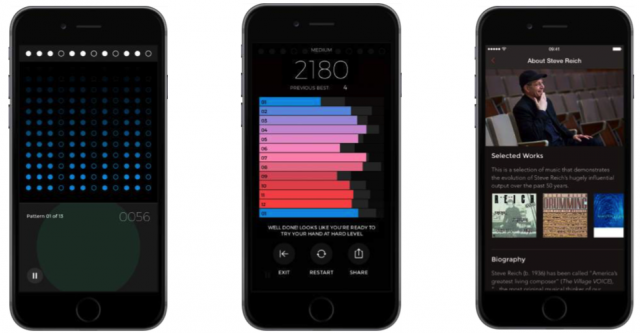
You can thank London-based developer Touchpress for this app and others that explore teaching music through software. They already built The Orchestra, Julliard String Quartet, and Beethoven’s 9th Symphony, which offer interactive tours that let you experience those works in ways something like a book can’t provide. I’m really impressed by their apps – they’re accessible to total newcomers to music, and yet they’re still engaging to someone like me who’s been through years and years of classical music education. That’s no small challenge. And as a Clapping Music fan, it’s fun to see the work in a new way.
Part of why their apps work is that they pair talented developers and designers with the musical experts best able to cover the music. So in this case, we have Steve Reich, researchers from Queen Mary University of London, and the London Sinfonietta.
Two feature requests, though (a little unfair, given the app is free, but must be said):
1. Notation view.
2. Onset detection via the mic, so you can actually clap!
Because, oddly, all of this makes me think that maybe the age of apps and screens is the perfect time to rediscover making scores. There’s something really charming about this:

And we live in an era that truly gives us the opportunity for “and” rather than “either/or.”
can i turn the lights off with this ? 🙂
Yes, yes, yes, no, yes, yes, no, yes, no, yes, yes, no
can i turn the lights off with this ? 🙂
Yes, yes, yes, no, yes, yes, no, yes, no, yes, yes, no
can i turn the lights off with this ? 🙂
Yes, yes, yes, no, yes, yes, no, yes, no, yes, yes, no
I wish all music notation treated time the way you describe. It’s always been one of the most confusing and unintuitive things about traditional notation to me. The other thing being that the lines on the staff are much smaller than the spaces between them – so there’s not a proportional representation of different notes. These things force you to decode and translate visual symbols when trying to read music, instead of a simpler and more direct mapping of size / distance to time and pitch. It’s part of why I love step sequencers so much. Piano rolls can be nice too, but I find a really clear and obvious grid to be really helpful for fast composition. I also think that rock band / guitar hero style interfaces are really cool and it’d be cool if they were used more in actual music education (and not just musical games).
I wish all music notation treated time the way you describe. It’s always been one of the most confusing and unintuitive things about traditional notation to me. The other thing being that the lines on the staff are much smaller than the spaces between them – so there’s not a proportional representation of different notes. These things force you to decode and translate visual symbols when trying to read music, instead of a simpler and more direct mapping of size / distance to time and pitch. It’s part of why I love step sequencers so much. Piano rolls can be nice too, but I find a really clear and obvious grid to be really helpful for fast composition. I also think that rock band / guitar hero style interfaces are really cool and it’d be cool if they were used more in actual music education (and not just musical games).
I wish all music notation treated time the way you describe. It’s always been one of the most confusing and unintuitive things about traditional notation to me. The other thing being that the lines on the staff are much smaller than the spaces between them – so there’s not a proportional representation of different notes. These things force you to decode and translate visual symbols when trying to read music, instead of a simpler and more direct mapping of size / distance to time and pitch. It’s part of why I love step sequencers so much. Piano rolls can be nice too, but I find a really clear and obvious grid to be really helpful for fast composition. I also think that rock band / guitar hero style interfaces are really cool and it’d be cool if they were used more in actual music education (and not just musical games).
Touchpress…didn’t they do that app for Bjork too ( forgot the name, you know, the one that was released a full interactive album ) ?
Touchpress…didn’t they do that app for Bjork too ( forgot the name, you know, the one that was released a full interactive album ) ?
Touchpress…didn’t they do that app for Bjork too ( forgot the name, you know, the one that was released a full interactive album ) ?
great pattern for drum machines too 🙂
great pattern for drum machines too 🙂
great pattern for drum machines too 🙂