It happened just as Apple was giving us one thing many of us couldn’t imagine wanting (a watch), and one thing we definitely didn’t ask for (“buying” U2’s new record for us).
Apple quietly killed the iPod Classic. That is, the iPod touch lives on as an iOS handheld minus a cellular radio, and there’s an app on iOS. But there is no standalone device, with the as-expected discontinuation of iPod Classic. Correction: there is one. The US$49, 2GB iPod shuffle is still available. But it’s a pale shadow of the iPod line.
This is a big deal. It means that the iconic object that transformed music is beginning to look more like a blip in music history – the leading edge of a change, but only part of that change. The iPod brought digital music and big collections, it’s true. But it’s being supplanted by something that, while it still involves digital files and pocket-friendly players on the go, is a different animal. It’s music you stream rather than own. It’s listening on a range of multi-functional devices, rather than syncing a single dedicated player to a computer. It’s music as an app, or rather, music as apps. Think Brian Eno-constructed generative music, RjDj and interactive sounds, NINJAMM remixing Ninja Tune, apps you use at concerts, strange sonic toys from Björk, and more. Commercially successful or not, that doesn’t matter – you can’t re-establish boundaries once they’re gone.
Once you have an operating system, music is software, not media.
And once you have the Internet, software is service as well as app.
This shift has sent some people into an existential tailspin. Mat Honan, for instance, gets a bit dark over at a much-forwarded elegy at Wired:
I miss the time when we were still defined by our music. When our music was still our music. I miss being younger, with a head full of subversive ideas; white cables snaking down my neck, stolen songs in my pocket. There will never be an app for that.
I will miss the iPod as dedicated device, too; I’m not immune to nostalgia. But then the iPod can be grouped at the end of a movement rather than the beginning – the age of recorded media and media players, each as discrete objects. Once, it was the iPod itself that was heretical. The nostalgic moaning here was once levied against the iPod and MP3, as it replaced CDs, and CDs, as they replaced tapes, and tapes, as they replaced records. We mourned the feeling of needles and records, of big jackets, of dubbed mix tapes, of analog sound, of lossless digital sound, low fidelity, high fidelity – various characteristics, often missing from one format even as they’re found on another.
Maybe it’s time to cut out all the mourning of these particular embodiments of music and start to ask ourselves, what is it about music that we really like? What can it be, once it’s removed from humans in a room making it?
Reader DoAn Forest reminds us of a thought piece he made in video form back in 2011. It’s worth watching the whole thing, as a fascinating meditation on materiality and scale that considers the world beyond the superficial remembrance of someone’s Danish wedding or crappy waterproof case and earbuds or how subversive it was to pirate tunes. (Ahem, sorry, Wired.)
All That Is Solid Gold Melts Into Air from DoAn Forest on Vimeo.
All That Is Solid Gold Melts Into Air
We are left, then, with various characteristics of recorded music and its playback:
Physical media objects.
Artwork.
Collections and ownership.
Playlists and selection – that bit that “defines” us or not.
Dedicated playback objects (versus multifunctional ones), and whether they sit on our desk or travel with us.
Applications versus records.
Streams versus static media (be it analog or digital, really).
And then there’s the matter of what all this stuff means.

I suppose what I find odd about the press beyond the realm of musicians is that they’re so focused on connections to music that leave out the music itself. I understand why the music industry has this hangup: initially, they were worried that their power would be undercut by the loss of those bits of remade petroleum and the distribution apparatus required to get them into your ears. Now, I think, the industry has realized that overabundance is itself a new opportunity to consolidate power and control what we hear and who gets paid, but that’s a matter for another story.
For now, I would ask instead: was it really the earbuds, the waterproof case, the jog wheel that you remember? Or, if you call up the chorus of the song you once fell in love to on Spotify or even a crappy YouTube stream, wouldn’t you have the same lump in your throat?
Music is invisible and ephemeral. It can make us cry in our quiet moments, piped invisibly into our ears, because that is the nature of sound.
Of course, we want to collect and own because we are creatures of a consumer culture that does such things, or because some ancient, primeval hoarding instinct drives us, or because our minds like the association of memory with objects. And record jackets are magical because they make those invisible things visible, and they create other worlds, acid trip journeys into outer space and lineups of Beatles in marching outfits.
It’s clear that we’re still fumbling our way to solutions here. Records, in fact, have lasting appeal as objects despite (or because of) their ungainly size. Download stores aren’t yet out of business, and indeed expand with the rising popularity of DJing. There are two fundamental questions raised by the loss of the iPod, then.

Collections. The iPod was special in that it associated a particular collection of music with an object that stored it. (The “pod” is the clue.) As the film above suggests, it’s the materiality of the record crate without the weight and space. It’s obviously not dead yet, either, given that people lined up to spend hundreds of dollars on extra storage for the iPhone introduced this week. The Wired story gets at this collection quality, but does little to suggest the optimal way this would work. It seems that with instant-on streaming, collections become more important, not less. Proper collections were much-requested on Spotify, for instance; the absence there seems more to do with Spotify’s inability to implement the feature than a lack of demand. Music does still define us; the issue is that we have difficulty expressing that definition in the blurred space of the cloud.
The iPod Classic was beautiful in that it was so freaking huge; it could contain everything you love. If anything, online streaming services have something similar. The challenge now is to allow users to draw that line between “me” and “everything else.” To my mind, nothing has done this quite as perfectly as a cassette mix tape, though that’s obviously an anachronism.
Streams are soulless and impersonal. But that doesn’t mean it will make people the same way. On the contrary: those service won’t survive unless they can find a way to get back to what the user is passionate about. Oh, yeah, and about the players.
Apple showed their own lack of understanding of the problem with this week’s U2 announcement. It’s the low point of digital music: a record you bought without buying it. At least when I play a stream, I meant to play a stream. This is like a car radio stuck on a single station, permanently switched on. While writing this, actually, I called up an old U2 track I actually like, one connected to memory.
Dedicated players. It’s clear what the average music listener wants; they want to listen to music. They want that music wherever they are, whether in a car or on a jog or in the shower.
The iPod was never a very good serious dedicated player. I miss the amount of storage on Classic, but I think the Internet connectivity of the iPhone and iPod touch are perfectly lovely. If you really want a dedicated player, get an iPod touch and delete the extra apps.
But then, if you want a dedicated player, you might want something with greater audio fidelity. The thing is, an iPod just isn’t that different from anything else. That’s where players like the FiiO get interesting. The iPod getting out of the way leaves extra space for dedicated niche players. The challenge for these devices is to demonstrate that higher fidelity is something you can hear. A funny thing has happened in Berlin – the lovers of obsessive-compulsive details of bass drums I know have started to get addicted to just this sort of listening. I’d want some double blind testing myself on different kinds of music to convince me, but there’s some potential there. And I have no doubt that we can represent sound with something better than 2-channel, conventional stereo at compressed lossy 16-bit 44.1kHz. Our ears and brain have a lot more potential than that.
Update: I feel obligated to mention the iPod touch. I think it’s terrific hardware at US$299 for 64GB, if you don’t have pockets deep enough for these audiophile-focused players. And, frankly, I think an iOS device is a better way to listen to a mix of, say, podcasts, SoundCloud, and music. There’s no reason you couldn’t dedicate this to music playback, which would answer complaints in comments about battery life and distractions. And it sounds pretty darn good when paired with nice headphones (consider an amp if you want to get really picky); you can even fit a fair bit of lossless compressed music in 64 gigs – compare a record crate’s storage, as above. If that still doesn’t satisfy you, you can consider one of the higher-end models from the likes of Sony now entering the market. So, again, there seems to be more hair pulling on this issue than necessary.
Listening technology lags listening
Let’s not write a sad song for the iPod. The iPhone is about as subversive as a bag of potato chips, Wired? Come on. The iPod was about as subversive as a bag of sour cream potato chips. This is subversive. D motherf***, D. Anyway, now Bed-Stuy I’m sure was one of the neighborhoods breaking the iPhone 6 Plus preorder. So yeah, times change.
Let’s instead look at the sad state of collection and playback.
I think ultimately it isn’t the vinyl we miss, or the iPods. I think we miss the moment when a love song meant something different, some deeper nostalgias that drive those journalists. To be human is to sometimes love and miss the past, far beyond any particular bits of plastic. Musicians have always spoken to those feelings; we earn our living on it. Now that we’re not strumming around a campfire and singing until people cry, some middle men have to work out how to let listeners find the right song.
My guess is, the day will come when people look back at the spreadsheets of tracks to stream and mostly no one will miss them.
Yes, U2 is the soundtrack to this whole conundrum in which the record industry finds itself. Not a requiem for the iPod.
“I still haven’t found what I’m looking for.”
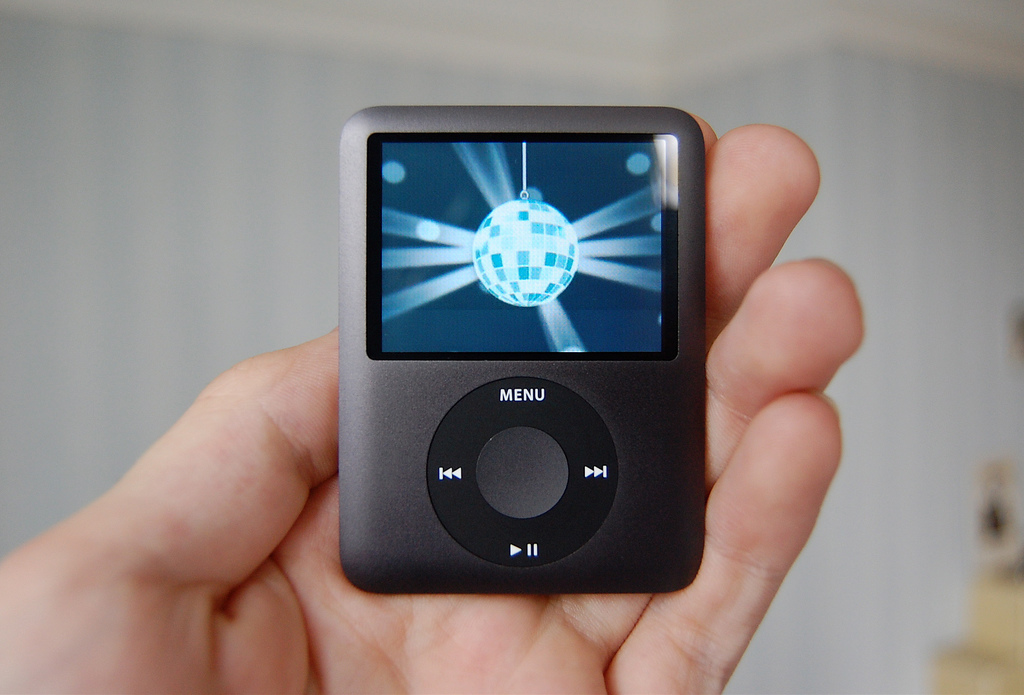
Photo credits, from top: an iPod nano, (CC-BY-SA) Andrew*, a wall of tapes (CC-BY) cassettes on Flickr), media artist Marisa Olson building a monument to DJ culture at Bard College CC-BY-SA) Michael Mandiberg.
Awesome Radio Raheem reference :-)!
Awesome Radio Raheem reference :-)!
Awesome Radio Raheem reference :-)!
It always seems like you write about something just as it’s been on my mind… I’ve been thinking about this a lot lately. One thing that not many people touch on that I would like to add to the discussion is the value we assign to music. Prior to digital you had to pick out and buy every album you owned. Your music defined you because you alone made the decision to make that purchase. You did so because that music had value to you. With streaming (and file sharing) access to nearly all music created for one low price means that you aren’t subconsciously assigning value to it. You aren’t INVESTED in it. If I buy an album I automatically have an urge to like it, to not have wasted my money. I think this is a powerful thing that is missing from streaming.
I listen to music in a lot of ways now… vinyl/cd/itunes/spotify/soundcloud/google. I miss having one place to go. Listening to music has become haphazard. It’s partly my own choice, but not everyone releases their music in the same format, the same quality. I’m always open to new possibilities, but each new way that gives us something better something easier, often loses what was great about the way that was replaced.
It always seems like you write about something just as it’s been on my mind… I’ve been thinking about this a lot lately. One thing that not many people touch on that I would like to add to the discussion is the value we assign to music. Prior to digital you had to pick out and buy every album you owned. Your music defined you because you alone made the decision to make that purchase. You did so because that music had value to you. With streaming (and file sharing) access to nearly all music created for one low price means that you aren’t subconsciously assigning value to it. You aren’t INVESTED in it. If I buy an album I automatically have an urge to like it, to not have wasted my money. I think this is a powerful thing that is missing from streaming.
I listen to music in a lot of ways now… vinyl/cd/itunes/spotify/soundcloud/google. I miss having one place to go. Listening to music has become haphazard. It’s partly my own choice, but not everyone releases their music in the same format, the same quality. I’m always open to new possibilities, but each new way that gives us something better something easier, often loses what was great about the way that was replaced.
It always seems like you write about something just as it’s been on my mind… I’ve been thinking about this a lot lately. One thing that not many people touch on that I would like to add to the discussion is the value we assign to music. Prior to digital you had to pick out and buy every album you owned. Your music defined you because you alone made the decision to make that purchase. You did so because that music had value to you. With streaming (and file sharing) access to nearly all music created for one low price means that you aren’t subconsciously assigning value to it. You aren’t INVESTED in it. If I buy an album I automatically have an urge to like it, to not have wasted my money. I think this is a powerful thing that is missing from streaming.
I listen to music in a lot of ways now… vinyl/cd/itunes/spotify/soundcloud/google. I miss having one place to go. Listening to music has become haphazard. It’s partly my own choice, but not everyone releases their music in the same format, the same quality. I’m always open to new possibilities, but each new way that gives us something better something easier, often loses what was great about the way that was replaced.
Hi Peter,
I just can’t agree with your statement that it isn’t the vinyl we miss, for the lovers of vinyl it IS the ‘collection’, and in particular the physicality of, (in particular) the substantial artwork of the vinyl package, right down to the paper types, the vinyl thickness or color, the smell of ink from that rare 1977 copy you paid way too much for. And this runs into the question of ownership, I don’t believe that people who reject the streaming model do so because of a selfish need to ‘own’ the music. If anything it’s more that once you have discovered music (or an actual copy) that you cherish, people do not want a rented facsimile of that music, that could obliterated from existence by anything from failing to keep up monthly payments, to computer error to ‘retroactive’ censorship (as we’ve seen with Amazon purchased digital books).
There was never anything wrong with the model of people gathering a music collection, whether that was in the form of physical records, mixtapes on cassette right up to DRM-less files. I see little difference between this and someone who collects their favorite pokemon cards or Lego figures, or your grandma collecting her favorite teacups or cute pictures of dogs. Humans become attached to things, hell, we are in the music production business, just about everyone cherishes items, guitars, 70s/80s synths, that rare pedal you bought off a friend that you’ll *never* sell.
The problem with the thrust of your article is the idea that we don’t need to care about this any more now that we have ubiquitous streaming and just about any piece of music is in reach, even if that is only through finding it on a youtube rip. But the music wasn’t always just about the music, it was about the music plus the paraphernalia of the bands, the T shirt, the gig ticket, the look and lifestyle of a scene that you follow, the mixtape a friend gave you that put you onto band x, y and z that you went out and bought for yourself. The flaw in the ‘this is all ok because we have streaming’ argument is that no, everyone doesn’t have streaming. What you have are a number of disparate streaming services, some ad supported, some paid, all carrying different catalogs, and the elephant in the room is that you are requiring people to have access to 3G or 4G connections to play this catalog. You need to step outside the metropolitan bubble for a moment and realise that for the vast majority of people in fact this kind of ubiquitous streaming still isn’t viable, and also that where people do have access to streaming, perhaps they just don’t want to? You know, along the lines of irradiating their groin from the phone in their pocket just to play 4 hours of music on the go…
…and bear in mind that what the iPod classic allowed people to do was to carry 11 hours of battery life for the music alone, independent of the phone they are carrying, good luck with that on a 4G connection all day.
OK I may be in the 1% who care about having a good quality portable player (no I’m not an audiophile into $1000-a-meter ‘directional’ audio cables), but simply having a high capacity high fidelity player with a strong headphone amp and physical buttons (yes, please, goddamit buttons I can press when I’m in the gym without fumbling with a touchscreen lock) there’s nothing wrong with still wanting a device like that, which is why there has been a good amount of coverage even just this past couple of weeks for Sony’s new (pono-killing?) walkman.
I’m pretty sure that most serious musicians would also much rather their listeners could hear the music in at least 16bit 44.1khz lossless on a device like that than playing out of the 99-cents opamp on their android phone, reduced to 64kbps just to allow it to stream smoothly from Spotify (who pay the artist 0.00000000000000000037 cents per billion plays or something)
The thrust of the article was that audio fidelity doesn’t matter and that we should all use crap streaming connections? Uh, don’t think so; not sure why that came across.
No, I agree with you on the need for better audio players, and niche ones for those who care, which is why… I say that fairly explicitly.
As for the smell of the ink on a rare 1977 release, well, that’s the very definition of fetish. Like I said, I don’t deny the appeal there, only that it doesn’t speak to the appeal of the actual music, which I think you can’t leave out. And by the point we’re fetishizing the iPod, something odd has happened.
The battery life concerns I think are not reason to go completely nuts here, as Apple have vastly improved battery life and many people use third-party batteries – which is reasonable weight if you’re talking about carrying an iPad Classic, too. And if audio fidelity matters, then why not get a niche player?
Actually, you’re making a couple of arguments here I could quote directly from above.
On the vinyl thing, the method of listening matters to me personally. It forces me a wee bit into monotasking and actually paying attention. Listening to vinyl records with friends is a different ritual all together as compared to listening to streams while barely paying attention (as a large %tage of people appears to be doing).
In the end, I use both. Streaming, I use it everywhere else basically (mostly work). Also mostly I’ld want control over the playlist content with the exceptions being some shows at wfmu or resonance fm. Basically “radio” formats that actually introduce me to things I haven’t heard before (in the true meaning of the statement, as those experiences of discovery have thinned out quite a bit lately). My previous point on monotasking and attention spans also seems to have an influence over content formats. Albums? Who listens to whole albums these days?
I listen to whole albums. Actually, seems perfectly easy to do that on the streaming services, too. I think it depends on the album.
But this question of monotasking isn’t a new one. People have long run radios in the background, car stereos, and so on.
I certainly appreciate that records encourage that behavior. But there are ways of bringing that discipline back.
Anyway, this brings me back to the question of the music. It’s not that the delivery method is unimportant. But surely the content matters, too. Is this a record that invites you listen from start to finish? Can it actually grab your attention and make a coherent statement?
Then, the question is whether the technology gets in your way. Spotify’s long-missing collections feature was a real obstacle; it still could work better than it does.
I didn’t mean noone does listen to whole albums, but the majority does not. But you’re right. Neither that nor the question of monotasking isn’t new, but it does seem that it has intensified.
And of course the content matters, but where you say, does it invite you to listen from start to finish, I would ask: Have strategies changed to adapt to a change in listening patterns that was present before to some degree (think of how many people listened to only one or two tracks on an album due to the comfort of familiarity as a consequence to exposure by tv/radio/shops) and has been intensified by streams/mixes rather than albums/eps? Maybe take online skipping statistics into the equation too?
Back to the vinyl. The mechanical ritual of it has the effect on me as described in my previous comment. It is simply a lot easier to get distracted when a computer or smartphone device is the source of entertainment. You’re not forced to move your ass to switch sides etc. I’m curious though. What ways do you see of bringing that discipline back?
Why would you want it back? I listen much more intently to music when I’m actually doing something else. The last I want is to have to clean up my hands in the middle of making pizza so that I can flip the record.
Sitting and focusing on the music is something I haven’t done in decades, and I don’t really see myself ever doing it again. As for listening to whole albums this way … sheesh, one song is enough to focus on if you’re going to go deep.
Hi Peter,
I just can’t agree with your statement that it isn’t the vinyl we miss, for the lovers of vinyl it IS the ‘collection’, and in particular the physicality of, (in particular) the substantial artwork of the vinyl package, right down to the paper types, the vinyl thickness or color, the smell of ink from that rare 1977 copy you paid way too much for. And this runs into the question of ownership, I don’t believe that people who reject the streaming model do so because of a selfish need to ‘own’ the music. If anything it’s more that once you have discovered music (or an actual copy) that you cherish, people do not want a rented facsimile of that music, that could obliterated from existence by anything from failing to keep up monthly payments, to computer error to ‘retroactive’ censorship (as we’ve seen with Amazon purchased digital books).
There was never anything wrong with the model of people gathering a music collection, whether that was in the form of physical records, mixtapes on cassette right up to DRM-less files. I see little difference between this and someone who collects their favorite pokemon cards or Lego figures, or your grandma collecting her favorite teacups or cute pictures of dogs. Humans become attached to things, hell, we are in the music production business, just about everyone cherishes items, guitars, 70s/80s synths, that rare pedal you bought off a friend that you’ll *never* sell.
The problem with the thrust of your article is the idea that we don’t need to care about this any more now that we have ubiquitous streaming and just about any piece of music is in reach, even if that is only through finding it on a youtube rip. But the music wasn’t always just about the music, it was about the music plus the paraphernalia of the bands, the T shirt, the gig ticket, the look and lifestyle of a scene that you follow, the mixtape a friend gave you that put you onto band x, y and z that you went out and bought for yourself. The flaw in the ‘this is all ok because we have streaming’ argument is that no, everyone doesn’t have streaming. What you have are a number of disparate streaming services, some ad supported, some paid, all carrying different catalogs, and the elephant in the room is that you are requiring people to have access to 3G or 4G connections to play this catalog. You need to step outside the metropolitan bubble for a moment and realise that for the vast majority of people in fact this kind of ubiquitous streaming still isn’t viable, and also that where people do have access to streaming, perhaps they just don’t want to? You know, along the lines of irradiating their groin from the phone in their pocket just to play 4 hours of music on the go…
…and bear in mind that what the iPod classic allowed people to do was to carry 11 hours of battery life for the music alone, independent of the phone they are carrying, good luck with that on a 4G connection all day.
OK I may be in the 1% who care about having a good quality portable player (no I’m not an audiophile into $1000-a-meter ‘directional’ audio cables), but simply having a high capacity high fidelity player with a strong headphone amp and physical buttons (yes, please, goddamit buttons I can press when I’m in the gym without fumbling with a touchscreen lock) there’s nothing wrong with still wanting a device like that, which is why there has been a good amount of coverage even just this past couple of weeks for Sony’s new (pono-killing?) walkman.
I’m pretty sure that most serious musicians would also much rather their listeners could hear the music in at least 16bit 44.1khz lossless on a device like that than playing out of the 99-cents opamp on their android phone, reduced to 64kbps just to allow it to stream smoothly from Spotify (who pay the artist 0.00000000000000000037 cents per billion plays or something)
The thrust of the article was that audio fidelity doesn’t matter and that we should all use crap streaming connections? Uh, don’t think so; not sure why that came across.
No, I agree with you on the need for better audio players, and niche ones for those who care, which is why… I say that fairly explicitly.
As for the smell of the ink on a rare 1977 release, well, that’s the very definition of fetish. Like I said, I don’t deny the appeal there, only that it doesn’t speak to the appeal of the actual music, which I think you can’t leave out. And by the point we’re fetishizing the iPod, something odd has happened.
The battery life concerns I think are not reason to go completely nuts here, as Apple have vastly improved battery life and many people use third-party batteries – which is reasonable weight if you’re talking about carrying an iPad Classic, too. And if audio fidelity matters, then why not get a niche player?
Actually, you’re making a couple of arguments here I could quote directly from above.
On the vinyl thing, the method of listening matters to me personally. It forces me a wee bit into monotasking and actually paying attention. Listening to vinyl records with friends is a different ritual all together as compared to listening to streams while barely paying attention (as a large %tage of people appears to be doing).
In the end, I use both. Streaming, I use it everywhere else basically (mostly work). Also mostly I’ld want control over the playlist content with the exceptions being some shows at wfmu or resonance fm. Basically “radio” formats that actually introduce me to things I haven’t heard before (in the true meaning of the statement, as those experiences of discovery have thinned out quite a bit lately). My previous point on monotasking and attention spans also seems to have an influence over content formats. Albums? Who listens to whole albums these days?
I listen to whole albums. Actually, seems perfectly easy to do that on the streaming services, too. I think it depends on the album.
But this question of monotasking isn’t a new one. People have long run radios in the background, car stereos, and so on.
I certainly appreciate that records encourage that behavior. But there are ways of bringing that discipline back.
Anyway, this brings me back to the question of the music. It’s not that the delivery method is unimportant. But surely the content matters, too. Is this a record that invites you listen from start to finish? Can it actually grab your attention and make a coherent statement?
Then, the question is whether the technology gets in your way. Spotify’s long-missing collections feature was a real obstacle; it still could work better than it does.
I didn’t mean noone does listen to whole albums, but the majority does not. But you’re right. Neither that nor the question of monotasking isn’t new, but it does seem that it has intensified.
And of course the content matters, but where you say, does it invite you to listen from start to finish, I would ask: Have strategies changed to adapt to a change in listening patterns that was present before to some degree (think of how many people listened to only one or two tracks on an album due to the comfort of familiarity as a consequence to exposure by tv/radio/shops) and has been intensified by streams/mixes rather than albums/eps? Maybe take online skipping statistics into the equation too?
Back to the vinyl. The mechanical ritual of it has the effect on me as described in my previous comment. It is simply a lot easier to get distracted when a computer or smartphone device is the source of entertainment. You’re not forced to move your ass to switch sides etc. I’m curious though. What ways do you see of bringing that discipline back?
Why would you want it back? I listen much more intently to music when I’m actually doing something else. The last I want is to have to clean up my hands in the middle of making pizza so that I can flip the record.
Sitting and focusing on the music is something I haven’t done in decades, and I don’t really see myself ever doing it again. As for listening to whole albums this way … sheesh, one song is enough to focus on if you’re going to go deep.
Hi Peter,
I just can’t agree with your statement that it isn’t the vinyl we miss, for the lovers of vinyl it IS the ‘collection’, and in particular the physicality of, (in particular) the substantial artwork of the vinyl package, right down to the paper types, the vinyl thickness or color, the smell of ink from that rare 1977 copy you paid way too much for. And this runs into the question of ownership, I don’t believe that people who reject the streaming model do so because of a selfish need to ‘own’ the music. If anything it’s more that once you have discovered music (or an actual copy) that you cherish, people do not want a rented facsimile of that music, that could obliterated from existence by anything from failing to keep up monthly payments, to computer error to ‘retroactive’ censorship (as we’ve seen with Amazon purchased digital books).
There was never anything wrong with the model of people gathering a music collection, whether that was in the form of physical records, mixtapes on cassette right up to DRM-less files. I see little difference between this and someone who collects their favorite pokemon cards or Lego figures, or your grandma collecting her favorite teacups or cute pictures of dogs. Humans become attached to things, hell, we are in the music production business, just about everyone cherishes items, guitars, 70s/80s synths, that rare pedal you bought off a friend that you’ll *never* sell.
The problem with the thrust of your article is the idea that we don’t need to care about this any more now that we have ubiquitous streaming and just about any piece of music is in reach, even if that is only through finding it on a youtube rip. But the music wasn’t always just about the music, it was about the music plus the paraphernalia of the bands, the T shirt, the gig ticket, the look and lifestyle of a scene that you follow, the mixtape a friend gave you that put you onto band x, y and z that you went out and bought for yourself. The flaw in the ‘this is all ok because we have streaming’ argument is that no, everyone doesn’t have streaming. What you have are a number of disparate streaming services, some ad supported, some paid, all carrying different catalogs, and the elephant in the room is that you are requiring people to have access to 3G or 4G connections to play this catalog. You need to step outside the metropolitan bubble for a moment and realise that for the vast majority of people in fact this kind of ubiquitous streaming still isn’t viable, and also that where people do have access to streaming, perhaps they just don’t want to? You know, along the lines of irradiating their groin from the phone in their pocket just to play 4 hours of music on the go…
…and bear in mind that what the iPod classic allowed people to do was to carry 11 hours of battery life for the music alone, independent of the phone they are carrying, good luck with that on a 4G connection all day.
OK I may be in the 1% who care about having a good quality portable player (no I’m not an audiophile into $1000-a-meter ‘directional’ audio cables), but simply having a high capacity high fidelity player with a strong headphone amp and physical buttons (yes, please, goddamit buttons I can press when I’m in the gym without fumbling with a touchscreen lock) there’s nothing wrong with still wanting a device like that, which is why there has been a good amount of coverage even just this past couple of weeks for Sony’s new (pono-killing?) walkman.
I’m pretty sure that most serious musicians would also much rather their listeners could hear the music in at least 16bit 44.1khz lossless on a device like that than playing out of the 99-cents opamp on their android phone, reduced to 64kbps just to allow it to stream smoothly from Spotify (who pay the artist 0.00000000000000000037 cents per billion plays or something)
The thrust of the article was that audio fidelity doesn’t matter and that we should all use crap streaming connections? Uh, don’t think so; not sure why that came across.
No, I agree with you on the need for better audio players, and niche ones for those who care, which is why… I say that fairly explicitly.
As for the smell of the ink on a rare 1977 release, well, that’s the very definition of fetish. Like I said, I don’t deny the appeal there, only that it doesn’t speak to the appeal of the actual music, which I think you can’t leave out. And by the point we’re fetishizing the iPod, something odd has happened.
The battery life concerns I think are not reason to go completely nuts here, as Apple have vastly improved battery life and many people use third-party batteries – which is reasonable weight if you’re talking about carrying an iPad Classic, too. And if audio fidelity matters, then why not get a niche player?
Actually, you’re making a couple of arguments here I could quote directly from above.
On the vinyl thing, the method of listening matters to me personally. It forces me a wee bit into monotasking and actually paying attention. Listening to vinyl records with friends is a different ritual all together as compared to listening to streams while barely paying attention (as a large %tage of people appears to be doing).
In the end, I use both. Streaming, I use it everywhere else basically (mostly work). Also mostly I’ld want control over the playlist content with the exceptions being some shows at wfmu or resonance fm. Basically “radio” formats that actually introduce me to things I haven’t heard before (in the true meaning of the statement, as those experiences of discovery have thinned out quite a bit lately). My previous point on monotasking and attention spans also seems to have an influence over content formats. Albums? Who listens to whole albums these days?
I listen to whole albums. Actually, seems perfectly easy to do that on the streaming services, too. I think it depends on the album.
But this question of monotasking isn’t a new one. People have long run radios in the background, car stereos, and so on.
I certainly appreciate that records encourage that behavior. But there are ways of bringing that discipline back.
Anyway, this brings me back to the question of the music. It’s not that the delivery method is unimportant. But surely the content matters, too. Is this a record that invites you listen from start to finish? Can it actually grab your attention and make a coherent statement?
Then, the question is whether the technology gets in your way. Spotify’s long-missing collections feature was a real obstacle; it still could work better than it does.
I didn’t mean noone does listen to whole albums, but the majority does not. But you’re right. Neither that nor the question of monotasking isn’t new, but it does seem that it has intensified.
And of course the content matters, but where you say, does it invite you to listen from start to finish, I would ask: Have strategies changed to adapt to a change in listening patterns that was present before to some degree (think of how many people listened to only one or two tracks on an album due to the comfort of familiarity as a consequence to exposure by tv/radio/shops) and has been intensified by streams/mixes rather than albums/eps? Maybe take online skipping statistics into the equation too?
Back to the vinyl. The mechanical ritual of it has the effect on me as described in my previous comment. It is simply a lot easier to get distracted when a computer or smartphone device is the source of entertainment. You’re not forced to move your ass to switch sides etc. I’m curious though. What ways do you see of bringing that discipline back?
Why would you want it back? I listen much more intently to music when I’m actually doing something else. The last I want is to have to clean up my hands in the middle of making pizza so that I can flip the record.
Sitting and focusing on the music is something I haven’t done in decades, and I don’t really see myself ever doing it again. As for listening to whole albums this way … sheesh, one song is enough to focus on if you’re going to go deep.
I still feel stuck with those 10 boxes of records in my basement – ugh. I love the streaming model. One of the fondest musical memories I have is when I bought those 7 Maurizio records, burned them to unlabeled CDs, put them in the CD changer in my trunk, and drove around listening to them for a whole summer.
I know I’m in the minority or rabid music fans who don’t care much for the physical object; it’s the listening experience and discovery experience which counts most for me.
I still feel stuck with those 10 boxes of records in my basement – ugh. I love the streaming model. One of the fondest musical memories I have is when I bought those 7 Maurizio records, burned them to unlabeled CDs, put them in the CD changer in my trunk, and drove around listening to them for a whole summer.
I know I’m in the minority or rabid music fans who don’t care much for the physical object; it’s the listening experience and discovery experience which counts most for me.
I still feel stuck with those 10 boxes of records in my basement – ugh. I love the streaming model. One of the fondest musical memories I have is when I bought those 7 Maurizio records, burned them to unlabeled CDs, put them in the CD changer in my trunk, and drove around listening to them for a whole summer.
I know I’m in the minority or rabid music fans who don’t care much for the physical object; it’s the listening experience and discovery experience which counts most for me.
Great article, lots of import points and implications of music going all digital / streaming. Part of the problem is the music industry always wants to shoehorn the old media types into the new technologies. Like when vinyl gave way to cassettes which gave way to CDs, it took a few years before composers and artists said, hey we’re not constrained by having an album be two 20 minute collections of songs (A Side B Side) and began to explore releasing music that was 60-80 minutes long (admittedly with lots of filler and fluff). I think as artists it’s up to us to help push the boundaries of what digital music can be by embracing what now is going to be an perpetually changing model of how people experience music. This will happen by music makers and presenters embracing many of the things Peter mentions from interactive Apps, surround sound installations, modular / generative music, etc. For my own work I took inspiration from RjDj and released an ambient album where the listener’s sound world was mixed in with the music I recorded and just last week I released an eight-hour long album of ambient music to sleep to – https://mikronesia.bandcamp.com/album/quiescent. Neither of these projects would have been possible if we were just interested in taking the vinyl record LP format, keeping the same confines of length and musical structure and just making cheaper more portable versions of the media for consumers. The switch from physical media to digital is just entering a new creative phase where it’s not just about cheaper, easier to reproduce copies of the music.
Fantastic work.
thanks!
Great article, lots of import points and implications of music going all digital / streaming. Part of the problem is the music industry always wants to shoehorn the old media types into the new technologies. Like when vinyl gave way to cassettes which gave way to CDs, it took a few years before composers and artists said, hey we’re not constrained by having an album be two 20 minute collections of songs (A Side B Side) and began to explore releasing music that was 60-80 minutes long (admittedly with lots of filler and fluff). I think as artists it’s up to us to help push the boundaries of what digital music can be by embracing what now is going to be an perpetually changing model of how people experience music. This will happen by music makers and presenters embracing many of the things Peter mentions from interactive Apps, surround sound installations, modular / generative music, etc. For my own work I took inspiration from RjDj and released an ambient album where the listener’s sound world was mixed in with the music I recorded and just last week I released an eight-hour long album of ambient music to sleep to – https://mikronesia.bandcamp.com/album/quiescent. Neither of these projects would have been possible if we were just interested in taking the vinyl record LP format, keeping the same confines of length and musical structure and just making cheaper more portable versions of the media for consumers. The switch from physical media to digital is just entering a new creative phase where it’s not just about cheaper, easier to reproduce copies of the music.
Fantastic work.
thanks!
Great article, lots of import points and implications of music going all digital / streaming. Part of the problem is the music industry always wants to shoehorn the old media types into the new technologies. Like when vinyl gave way to cassettes which gave way to CDs, it took a few years before composers and artists said, hey we’re not constrained by having an album be two 20 minute collections of songs (A Side B Side) and began to explore releasing music that was 60-80 minutes long (admittedly with lots of filler and fluff). I think as artists it’s up to us to help push the boundaries of what digital music can be by embracing what now is going to be an perpetually changing model of how people experience music. This will happen by music makers and presenters embracing many of the things Peter mentions from interactive Apps, surround sound installations, modular / generative music, etc. For my own work I took inspiration from RjDj and released an ambient album where the listener’s sound world was mixed in with the music I recorded and just last week I released an eight-hour long album of ambient music to sleep to – https://mikronesia.bandcamp.com/album/quiescent. Neither of these projects would have been possible if we were just interested in taking the vinyl record LP format, keeping the same confines of length and musical structure and just making cheaper more portable versions of the media for consumers. The switch from physical media to digital is just entering a new creative phase where it’s not just about cheaper, easier to reproduce copies of the music.
Fantastic work.
thanks!
No.
I want a dedicated player. I don’t want it jammed into my phone, which already is doing so many different things it has to spend part of the day plugged into a charger.
I want it to have enough storage to hold my collection.
I don’t want to stream music — that relies on having good connectivity, which I don’t in the 8th floor office where I work — and is much less energy-efficient than local storage.
And I want it to be affordable.
Oh look, I just described the hard-drive based Zunes and iPod Classics of the recent past…
I guess the affordable question is the sticking point on the niche players.
But let me ask this another way – do you want your music player to *lack* connectivity, specifically?
Apple still makes the iPod touch. With the WiFi radio switched off, its battery life is phenomenal. So then you’re mainly missing storage – but flash storage could be more affordable in time.
And you can get a 64GB iPod touch for US$299. That seems a pretty good deal.
I’ve been waiting for flash storage of sufficient size to be more affordable, and it hasn’t happened yet.
I have just barely under 128 GB of stuff on my Classic right now. I haven’t even begun an aggressive CD-ripping campaign yet — my car stereo is 13 years old and has no aux inputs, so I’ve been playing my older CDs in the car without ripping them. That will change as my car gives up the ghost.
64GB iPod touch for $300 doesn’t sound like much of a deal to me, when my refurbished 160GB classic was $250 if I recall correctly.
You can put a 64GB flash chip into a Sansa Clip+ and come out way ahead of $300. You can also have alternative 64GB flash cards to hold even more music (I have two). No spinning disk drive and somewhat waterproof. It is also tiny, and has amazing battery life.
Yes, though the user experience on the Sansas I think is relatively poor. Snapping up a Classic remains a good idea; I expect they’ll stick around.
Sansas are terrifically small, I agree, and the flash memory budget is incredible. But SanDisk aren’t terribly great at making usable interfaces.
Depends on the context. My iPod Touch is the worst music player I’ve ever encountered for use when working out. The touch interface is close to unusable under my workout conditions.
In the car … not so much.
I also put rockbox on my sansa(s) which does a little to improve the user experience.
But that isn’t a good deal is it when a 2TB portable drive can be had for a third of that. Not flash, not a dedicated music player, but I’d honestly rather drag around my small laptop and portable drive most of the time when traveling than dick around with iTunes constantly to swap new music onto my 7-year old 8GB iPod nano. Coughing up hundreds of dollars for a bit more space and the ability to watch fucking video on a tiny screen or whatever seems ludicrous when I also have a phone that does exactly the same thing.
I get the economics of it. If more people were buying them, they’d keep making them. Still, I think its a shame that I won’t be able to replace it with an iPod that has partly mechanical controls. I’m constantly pausing/playing/skipping without looking at the device. Next time around, I’ll be forced to fiddle with a touchscreen or some add-on cable widget. And by the way, touchscreens don’t work with wet fingers. My Nano does everyday even when I’m exercising and sweating. A touchscreen is a definite step backward for me in that scenario, which constitutes 99% of my iPod use. And please don’t say iPod Shuffle. That thing is not meant for active listeners.
No.
I want a dedicated player. I don’t want it jammed into my phone, which already is doing so many different things it has to spend part of the day plugged into a charger.
I want it to have enough storage to hold my collection.
I don’t want to stream music — that relies on having good connectivity, which I don’t in the 8th floor office where I work — and is much less energy-efficient than local storage.
And I want it to be affordable.
Oh look, I just described the hard-drive based Zunes and iPod Classics of the recent past…
I guess the affordable question is the sticking point on the niche players.
But let me ask this another way – do you want your music player to *lack* connectivity, specifically?
Apple still makes the iPod touch. With the WiFi radio switched off, its battery life is phenomenal. So then you’re mainly missing storage – but flash storage could be more affordable in time.
And you can get a 64GB iPod touch for US$299. That seems a pretty good deal.
I’ve been waiting for flash storage of sufficient size to be more affordable, and it hasn’t happened yet.
I have just barely under 128 GB of stuff on my Classic right now. I haven’t even begun an aggressive CD-ripping campaign yet — my car stereo is 13 years old and has no aux inputs, so I’ve been playing my older CDs in the car without ripping them. That will change as my car gives up the ghost.
64GB iPod touch for $300 doesn’t sound like much of a deal to me, when my refurbished 160GB classic was $250 if I recall correctly.
You can put a 64GB flash chip into a Sansa Clip+ and come out way ahead of $300. You can also have alternative 64GB flash cards to hold even more music (I have two). No spinning disk drive and somewhat waterproof. It is also tiny, and has amazing battery life.
Yes, though the user experience on the Sansas I think is relatively poor. Snapping up a Classic remains a good idea; I expect they’ll stick around.
Sansas are terrifically small, I agree, and the flash memory budget is incredible. But SanDisk aren’t terribly great at making usable interfaces.
Depends on the context. My iPod Touch is the worst music player I’ve ever encountered for use when working out. The touch interface is close to unusable under my workout conditions.
In the car … not so much.
I also put rockbox on my sansa(s) which does a little to improve the user experience.
But that isn’t a good deal is it when a 2TB portable drive can be had for a third of that. Not flash, not a dedicated music player, but I’d honestly rather drag around my small laptop and portable drive most of the time when traveling than dick around with iTunes constantly to swap new music onto my 7-year old 8GB iPod nano. Coughing up hundreds of dollars for a bit more space and the ability to watch fucking video on a tiny screen or whatever seems ludicrous when I also have a phone that does exactly the same thing.
I get the economics of it. If more people were buying them, they’d keep making them. Still, I think its a shame that I won’t be able to replace it with an iPod that has partly mechanical controls. I’m constantly pausing/playing/skipping without looking at the device. Next time around, I’ll be forced to fiddle with a touchscreen or some add-on cable widget. And by the way, touchscreens don’t work with wet fingers. My Nano does everyday even when I’m exercising and sweating. A touchscreen is a definite step backward for me in that scenario, which constitutes 99% of my iPod use. And please don’t say iPod Shuffle. That thing is not meant for active listeners.
No.
I want a dedicated player. I don’t want it jammed into my phone, which already is doing so many different things it has to spend part of the day plugged into a charger.
I want it to have enough storage to hold my collection.
I don’t want to stream music — that relies on having good connectivity, which I don’t in the 8th floor office where I work — and is much less energy-efficient than local storage.
And I want it to be affordable.
Oh look, I just described the hard-drive based Zunes and iPod Classics of the recent past…
I guess the affordable question is the sticking point on the niche players.
But let me ask this another way – do you want your music player to *lack* connectivity, specifically?
Apple still makes the iPod touch. With the WiFi radio switched off, its battery life is phenomenal. So then you’re mainly missing storage – but flash storage could be more affordable in time.
And you can get a 64GB iPod touch for US$299. That seems a pretty good deal.
I’ve been waiting for flash storage of sufficient size to be more affordable, and it hasn’t happened yet.
I have just barely under 128 GB of stuff on my Classic right now. I haven’t even begun an aggressive CD-ripping campaign yet — my car stereo is 13 years old and has no aux inputs, so I’ve been playing my older CDs in the car without ripping them. That will change as my car gives up the ghost.
64GB iPod touch for $300 doesn’t sound like much of a deal to me, when my refurbished 160GB classic was $250 if I recall correctly.
You can put a 64GB flash chip into a Sansa Clip+ and come out way ahead of $300. You can also have alternative 64GB flash cards to hold even more music (I have two). No spinning disk drive and somewhat waterproof. It is also tiny, and has amazing battery life.
Yes, though the user experience on the Sansas I think is relatively poor. Snapping up a Classic remains a good idea; I expect they’ll stick around.
Sansas are terrifically small, I agree, and the flash memory budget is incredible. But SanDisk aren’t terribly great at making usable interfaces.
Depends on the context. My iPod Touch is the worst music player I’ve ever encountered for use when working out. The touch interface is close to unusable under my workout conditions.
In the car … not so much.
I also put rockbox on my sansa(s) which does a little to improve the user experience.
But that isn’t a good deal is it when a 2TB portable drive can be had for a third of that. Not flash, not a dedicated music player, but I’d honestly rather drag around my small laptop and portable drive most of the time when traveling than dick around with iTunes constantly to swap new music onto my 7-year old 8GB iPod nano. Coughing up hundreds of dollars for a bit more space and the ability to watch fucking video on a tiny screen or whatever seems ludicrous when I also have a phone that does exactly the same thing.
I get the economics of it. If more people were buying them, they’d keep making them. Still, I think its a shame that I won’t be able to replace it with an iPod that has partly mechanical controls. I’m constantly pausing/playing/skipping without looking at the device. Next time around, I’ll be forced to fiddle with a touchscreen or some add-on cable widget. And by the way, touchscreens don’t work with wet fingers. My Nano does everyday even when I’m exercising and sweating. A touchscreen is a definite step backward for me in that scenario, which constitutes 99% of my iPod use. And please don’t say iPod Shuffle. That thing is not meant for active listeners.
Man, this was deemed to start a rave of a discussion. I think, this is a good article – much more thought-through and weighted that many other writings on this very topic.
Personally, I do agree with almost all of the aspects mentioned in this article and even in the comments so far. But – I believe there is an important thing to remember when discussing this:
1. The reason why this is such an emotionally laden topic is *not* the music. It is the fetishes around it. Collecting vinyl records (or CDs or cassettes or luxury box sets with DVD, posters, books… or any other physical media) that contain the actual music is one thing. Buying concert tickets (and keeping them for 30 years in a bloody show box in the attic!), t-shirts and all sorts of merchandising is the other thing. But that is – in my opinion – the normal, modern human, hoarding, collecting, owning *things* approach.
2. The actual music can come in any way, shape, form, channel, whatever. It does not matter. Not at all. Compressed mp3 files? Alright. Completely bass-free laptop speakers? No problem. High-fidelity copper cables between 10.000 € worth of stereo components? Whatever. Enjoying the music (and enjoying the nostalgic memories for that matter) is not ever limited to the media, or the quality of the presentation. I just had a blast the other Sunday, playing song snippets off the iTunes store with a friend, letting the memories and associations go, as if we’d been at a back-to-back DJ set. Just that we’d sit in front of two Macbooks and enjoyed ourselves. I just doesn’t matter.
3. And yes, then there is of course the other use case, that is sitting down and focusing on one piece of music entirely, not doing anything else besides that. Oh, and yes, many people (but not all!) would probably prefer to do this with high quality sound components from the player to the earbuds or loudspeakers to the media that the music is played off. But you know what? Truth is, that is a minority of people. We are an “elite” in the sense that we – as readers of this blog – are specifically bound to enjoy music, whether we just listen or make music ourselves.
4. From all the people I know, including family, friends, colleagues, friends of friends etc. I can just say that most of them listen to music while they do something else, e.g. on the way to work, at work, while doing household work, having friends over for dinner or whatever. Only very few of them actively decide to “do” music as a dedicated task.
5. And finally, I strongly believe that despite the fact that not everyone lives in a big city with great mobile or wifi connectivity, removing the iPod Classic from the portfolio is just a logical thing to do. There are still other options for those who want (or need) to carry a lot of music around without the need to have any sort of connection to be able to stream. It is most likely a question about technically streamlining their product portfolio, reducing the number of different OSes to maintain, hardware compatibility (30pin vs. Lightning..) and so on. Oh, and by the way, those who need a dedicated, high capacity player like this, will most likely already have purchased one – or can buy it right now in all sorts of shops around, before all stock gets sold out. And then, since it doesn’t connect to the internet, what’s the problem? There is no security update issue with the OS, and the ‘Pod will probably not stop working, just because Apple has stopped selling it.
I agree, definitely, on all five counts.
Actually, I wonder what the longevity of the Classic will be – it’s dependent on the internal hard drive, and I don’t know how hard those are to replace?
Someone it seems is destined to come up with a DIY solution. And we now have various “high-end” players to fill the gap.
And the iPod touch really is a good dedicated player. If the touch had the storage capacity of the Classic, then the only real complaint I could possibly come up with would be the larger size, but even that benefits its interface.
I do wonder, though, about thinking deeply about this question of music collections. I thought it was the interesting point raised by the Wired story, and there’s plenty more to contemplate there (which I don’t entirely get into here).
Definitely agree with all these points too, especially from a general perspective, but thought I’d chime in with my personal experience…
1. Listening on vinyl is currently a little more than half of my time spent consuming music. The thing is I couldn’t care less about my collection or even the artwork. It is the experience and the sound. I can’t tell you how many times I’ve listened to an album streaming and thought, eh it’s ok. Then I hear the vinyl and it comes alive and becomes one of my favorites. I agree that collecting is a HUGE part of it, but for me it’s simply the sound. But I can’t play vinyl everywhere, and that’s fine because…
2. mp3s are just so fantastic with how flexible they are. I can carry my collection around in my pocket and that is amazing. and the compressed quality doesn’t matter if I’m listening through crap headphones or laptops speakers. There is room for both and I 100% agree with that music can be enjoyed no matter how it’s being presented. I think more people need this more care-free view, but at the same time respect that quality can elevate the experience even further.
3. I think this has changed dramatically in recent years. Though I’m not completely ancient, I am of the age where a good portion of my music listening in my youth was in a room with a few friends or just myself, listening to a record start to finish, completely absorbed. This may be a minority now and I think it’s perpetuated by the current streaming/digital model. It’s just a little unfortunate that it isn’t more widespread as it used to be.
4. yup.
5. I think, if there was a market for the classic, then players like it will survive. It doesn’t have to be specifically the iPod. Who knows what will happen with Pono. Or if in the near future capacity will increase and cheap high capacity players will come back. Then will we all move to lossless cause we have the space?? By that time streaming might be too prevalent, if that even matters to most, which I think it does not.
Man, this was deemed to start a rave of a discussion. I think, this is a good article – much more thought-through and weighted that many other writings on this very topic.
Personally, I do agree with almost all of the aspects mentioned in this article and even in the comments so far. But – I believe there is an important thing to remember when discussing this:
1. The reason why this is such an emotionally laden topic is *not* the music. It is the fetishes around it. Collecting vinyl records (or CDs or cassettes or luxury box sets with DVD, posters, books… or any other physical media) that contain the actual music is one thing. Buying concert tickets (and keeping them for 30 years in a bloody show box in the attic!), t-shirts and all sorts of merchandising is the other thing. But that is – in my opinion – the normal, modern human, hoarding, collecting, owning *things* approach.
2. The actual music can come in any way, shape, form, channel, whatever. It does not matter. Not at all. Compressed mp3 files? Alright. Completely bass-free laptop speakers? No problem. High-fidelity copper cables between 10.000 € worth of stereo components? Whatever. Enjoying the music (and enjoying the nostalgic memories for that matter) is not ever limited to the media, or the quality of the presentation. I just had a blast the other Sunday, playing song snippets off the iTunes store with a friend, letting the memories and associations go, as if we’d been at a back-to-back DJ set. Just that we’d sit in front of two Macbooks and enjoyed ourselves. I just doesn’t matter.
3. And yes, then there is of course the other use case, that is sitting down and focusing on one piece of music entirely, not doing anything else besides that. Oh, and yes, many people (but not all!) would probably prefer to do this with high quality sound components from the player to the earbuds or loudspeakers to the media that the music is played off. But you know what? Truth is, that is a minority of people. We are an “elite” in the sense that we – as readers of this blog – are specifically bound to enjoy music, whether we just listen or make music ourselves.
4. From all the people I know, including family, friends, colleagues, friends of friends etc. I can just say that most of them listen to music while they do something else, e.g. on the way to work, at work, while doing household work, having friends over for dinner or whatever. Only very few of them actively decide to “do” music as a dedicated task.
5. And finally, I strongly believe that despite the fact that not everyone lives in a big city with great mobile or wifi connectivity, removing the iPod Classic from the portfolio is just a logical thing to do. There are still other options for those who want (or need) to carry a lot of music around without the need to have any sort of connection to be able to stream. It is most likely a question about technically streamlining their product portfolio, reducing the number of different OSes to maintain, hardware compatibility (30pin vs. Lightning..) and so on. Oh, and by the way, those who need a dedicated, high capacity player like this, will most likely already have purchased one – or can buy it right now in all sorts of shops around, before all stock gets sold out. And then, since it doesn’t connect to the internet, what’s the problem? There is no security update issue with the OS, and the ‘Pod will probably not stop working, just because Apple has stopped selling it.
I agree, definitely, on all five counts.
Actually, I wonder what the longevity of the Classic will be – it’s dependent on the internal hard drive, and I don’t know how hard those are to replace?
Someone it seems is destined to come up with a DIY solution. And we now have various “high-end” players to fill the gap.
And the iPod touch really is a good dedicated player. If the touch had the storage capacity of the Classic, then the only real complaint I could possibly come up with would be the larger size, but even that benefits its interface.
I do wonder, though, about thinking deeply about this question of music collections. I thought it was the interesting point raised by the Wired story, and there’s plenty more to contemplate there (which I don’t entirely get into here).
Definitely agree with all these points too, especially from a general perspective, but thought I’d chime in with my personal experience…
1. Listening on vinyl is currently a little more than half of my time spent consuming music. The thing is I couldn’t care less about my collection or even the artwork. It is the experience and the sound. I can’t tell you how many times I’ve listened to an album streaming and thought, eh it’s ok. Then I hear the vinyl and it comes alive and becomes one of my favorites. I agree that collecting is a HUGE part of it, but for me it’s simply the sound. But I can’t play vinyl everywhere, and that’s fine because…
2. mp3s are just so fantastic with how flexible they are. I can carry my collection around in my pocket and that is amazing. and the compressed quality doesn’t matter if I’m listening through crap headphones or laptops speakers. There is room for both and I 100% agree with that music can be enjoyed no matter how it’s being presented. I think more people need this more care-free view, but at the same time respect that quality can elevate the experience even further.
3. I think this has changed dramatically in recent years. Though I’m not completely ancient, I am of the age where a good portion of my music listening in my youth was in a room with a few friends or just myself, listening to a record start to finish, completely absorbed. This may be a minority now and I think it’s perpetuated by the current streaming/digital model. It’s just a little unfortunate that it isn’t more widespread as it used to be.
4. yup.
5. I think, if there was a market for the classic, then players like it will survive. It doesn’t have to be specifically the iPod. Who knows what will happen with Pono. Or if in the near future capacity will increase and cheap high capacity players will come back. Then will we all move to lossless cause we have the space?? By that time streaming might be too prevalent, if that even matters to most, which I think it does not.
Man, this was deemed to start a rave of a discussion. I think, this is a good article – much more thought-through and weighted that many other writings on this very topic.
Personally, I do agree with almost all of the aspects mentioned in this article and even in the comments so far. But – I believe there is an important thing to remember when discussing this:
1. The reason why this is such an emotionally laden topic is *not* the music. It is the fetishes around it. Collecting vinyl records (or CDs or cassettes or luxury box sets with DVD, posters, books… or any other physical media) that contain the actual music is one thing. Buying concert tickets (and keeping them for 30 years in a bloody show box in the attic!), t-shirts and all sorts of merchandising is the other thing. But that is – in my opinion – the normal, modern human, hoarding, collecting, owning *things* approach.
2. The actual music can come in any way, shape, form, channel, whatever. It does not matter. Not at all. Compressed mp3 files? Alright. Completely bass-free laptop speakers? No problem. High-fidelity copper cables between 10.000 € worth of stereo components? Whatever. Enjoying the music (and enjoying the nostalgic memories for that matter) is not ever limited to the media, or the quality of the presentation. I just had a blast the other Sunday, playing song snippets off the iTunes store with a friend, letting the memories and associations go, as if we’d been at a back-to-back DJ set. Just that we’d sit in front of two Macbooks and enjoyed ourselves. I just doesn’t matter.
3. And yes, then there is of course the other use case, that is sitting down and focusing on one piece of music entirely, not doing anything else besides that. Oh, and yes, many people (but not all!) would probably prefer to do this with high quality sound components from the player to the earbuds or loudspeakers to the media that the music is played off. But you know what? Truth is, that is a minority of people. We are an “elite” in the sense that we – as readers of this blog – are specifically bound to enjoy music, whether we just listen or make music ourselves.
4. From all the people I know, including family, friends, colleagues, friends of friends etc. I can just say that most of them listen to music while they do something else, e.g. on the way to work, at work, while doing household work, having friends over for dinner or whatever. Only very few of them actively decide to “do” music as a dedicated task.
5. And finally, I strongly believe that despite the fact that not everyone lives in a big city with great mobile or wifi connectivity, removing the iPod Classic from the portfolio is just a logical thing to do. There are still other options for those who want (or need) to carry a lot of music around without the need to have any sort of connection to be able to stream. It is most likely a question about technically streamlining their product portfolio, reducing the number of different OSes to maintain, hardware compatibility (30pin vs. Lightning..) and so on. Oh, and by the way, those who need a dedicated, high capacity player like this, will most likely already have purchased one – or can buy it right now in all sorts of shops around, before all stock gets sold out. And then, since it doesn’t connect to the internet, what’s the problem? There is no security update issue with the OS, and the ‘Pod will probably not stop working, just because Apple has stopped selling it.
I agree, definitely, on all five counts.
Actually, I wonder what the longevity of the Classic will be – it’s dependent on the internal hard drive, and I don’t know how hard those are to replace?
Someone it seems is destined to come up with a DIY solution. And we now have various “high-end” players to fill the gap.
And the iPod touch really is a good dedicated player. If the touch had the storage capacity of the Classic, then the only real complaint I could possibly come up with would be the larger size, but even that benefits its interface.
I do wonder, though, about thinking deeply about this question of music collections. I thought it was the interesting point raised by the Wired story, and there’s plenty more to contemplate there (which I don’t entirely get into here).
Definitely agree with all these points too, especially from a general perspective, but thought I’d chime in with my personal experience…
1. Listening on vinyl is currently a little more than half of my time spent consuming music. The thing is I couldn’t care less about my collection or even the artwork. It is the experience and the sound. I can’t tell you how many times I’ve listened to an album streaming and thought, eh it’s ok. Then I hear the vinyl and it comes alive and becomes one of my favorites. I agree that collecting is a HUGE part of it, but for me it’s simply the sound. But I can’t play vinyl everywhere, and that’s fine because…
2. mp3s are just so fantastic with how flexible they are. I can carry my collection around in my pocket and that is amazing. and the compressed quality doesn’t matter if I’m listening through crap headphones or laptops speakers. There is room for both and I 100% agree with that music can be enjoyed no matter how it’s being presented. I think more people need this more care-free view, but at the same time respect that quality can elevate the experience even further.
3. I think this has changed dramatically in recent years. Though I’m not completely ancient, I am of the age where a good portion of my music listening in my youth was in a room with a few friends or just myself, listening to a record start to finish, completely absorbed. This may be a minority now and I think it’s perpetuated by the current streaming/digital model. It’s just a little unfortunate that it isn’t more widespread as it used to be.
4. yup.
5. I think, if there was a market for the classic, then players like it will survive. It doesn’t have to be specifically the iPod. Who knows what will happen with Pono. Or if in the near future capacity will increase and cheap high capacity players will come back. Then will we all move to lossless cause we have the space?? By that time streaming might be too prevalent, if that even matters to most, which I think it does not.
Not completely sure that it’s what you mean, but I hate music apps as in music in the form of apps. There’s almost certain death for them after a few OS updates. I want the music I listen to to live longer, and I don’t want my phone to be cluttered with them.
IMO streaming is cool, but it’s complementary. Streaming catalogues will never be complete, and I’d hate to see music disappear due to licensing issues.
On a side note, is there a reason why you sometimes write »the iPod« and sometimes just »iPod«? I know that Apple does the latter, but I have to say that it makes me cringe…
Not completely sure that it’s what you mean, but I hate music apps as in music in the form of apps. There’s almost certain death for them after a few OS updates. I want the music I listen to to live longer, and I don’t want my phone to be cluttered with them.
IMO streaming is cool, but it’s complementary. Streaming catalogues will never be complete, and I’d hate to see music disappear due to licensing issues.
On a side note, is there a reason why you sometimes write »the iPod« and sometimes just »iPod«? I know that Apple does the latter, but I have to say that it makes me cringe…
Not completely sure that it’s what you mean, but I hate music apps as in music in the form of apps. There’s almost certain death for them after a few OS updates. I want the music I listen to to live longer, and I don’t want my phone to be cluttered with them.
IMO streaming is cool, but it’s complementary. Streaming catalogues will never be complete, and I’d hate to see music disappear due to licensing issues.
On a side note, is there a reason why you sometimes write »the iPod« and sometimes just »iPod«? I know that Apple does the latter, but I have to say that it makes me cringe…
i think everyone can still listen how they want to listen. just cause something is discontinued doesn’t mean apple comes a takes your iPod classic away from you. heck, for a while consumer record players were discontinued but that didn’t stop us from finding one and buying LP’s at the used record store. now we have more options, if i really need nostalgia on a flight from NY to LA, i’ll bring my battery powered Numark PT-01 and a bag full of records, or i’ll just bring my iPhone and listen to my records at home. 🙂
There was an alternative – the CD player, and my wife an I received one of the first consumer models for a wedding gift. For a while, we used both. Over time as more records became available on CD we switched, but I still have my turntable and we still have some vinyl. And there was an initial attempt to copy protect the CDs back then – it was short lived. I recall I believe Michael Jackson’s Thriller (or one of those) was the first copy protected CD – and there was some issue with it – wouldn’t play in certain players or something. A lot of kids my kids’ age are into vinyl. I don’t see the attraction, but whatever. As a drummer, I’ve lost a lot of high end in my left ear so I’m not qualified to be an “audiophile”, in the sense that I probably can’t hear as well as most people. But I know what a real piano sounds like vs digital. I can usually tell the difference (because of the overtones in the high end are not always captured properly – the other strings ring sympathetically depending on the chord played, making an N x N combination (or maybe N^N) of samples needed…..
this is incorrect. waves (acoustic pressure or otherwise) don’t work this way. if you can tell the difference (naturally, in a double blind test :), it isn’t because of anything like this. sampling theory is very straightforward: if the sampling frequency is N Hz, then it is possible to perfectly capture all frequencies up to N/2. this isn’t a subjective claim, it is a mathematical one that has been verified in the physical world in many different ways.
I disagree. If you play a “D” on the piano, other strings will resonate, especially if you have the pedal down. Which strings resonate depend on the frequency of the D, but also how well the piano is in tune, how hard you strike it, and perhaps the acoustics of the room. Now, play a d and f# together. Different strings will resonate than if you played the d and the f# separately. So, how do you sample this? you have one sample for the d by itself, and one if you happen to play the d and the f# together (and all combinations thereof). Go to a piano and try it. The theory is one thing. The real piano is another.
Ah, you mean “samples” as in “pre-recorded” samples. Sure. I was misreading what you wrote, and as a result I have deleted my comment there.
btw, physically modelled digital pianos don’t use samples. you might try giving pianoteq a good listen one day. the experience of playing it is totally different from an acoustic piano, but the experience of listening to a recording … much, much less so.
I mean, I understand the Nyquist sampling theorem, and all that. Math is a hobby of mine too (Dad was math teacher, sister was math major, I was musician, but the math rubbed off a bit). But when you’re dealing with 88 keys and 12 fingers, pedals, room acoustics, you can’t just hit one key and sample it and then hit the next key and sample it and expect it to sound like a real piano. It comes pretty darn close, and as Frank Z. once said, in a hocky rink who can tell the difference. And I’m sure the Yamaha digital pianos are getting better everyday. But I’ve yet to play one that sounds like a 17 foot yamaha grand piano.
10 fingers (what was I thinking!? :>) )
Let me add the same is true for drums. One of the great things about real drums on stage is the sympathetic resonance of the other drums. So, on a wooden floor stage, when you hit the “kick” (bass) drum, your tom toms resonate, adding higher harmonics and making the sound “fuller”. If you take away the toms, and just sample the bass drum, it’s not the same anymore. That’s why guys want a good “room sound” in the studio. So they get the sympathetic vibrations from their other drums.
i think everyone can still listen how they want to listen. just cause something is discontinued doesn’t mean apple comes a takes your iPod classic away from you. heck, for a while consumer record players were discontinued but that didn’t stop us from finding one and buying LP’s at the used record store. now we have more options, if i really need nostalgia on a flight from NY to LA, i’ll bring my battery powered Numark PT-01 and a bag full of records, or i’ll just bring my iPhone and listen to my records at home. 🙂
There was an alternative – the CD player, and my wife an I received one of the first consumer models for a wedding gift. For a while, we used both. Over time as more records became available on CD we switched, but I still have my turntable and we still have some vinyl. And there was an initial attempt to copy protect the CDs back then – it was short lived. I recall I believe Michael Jackson’s Thriller (or one of those) was the first copy protected CD – and there was some issue with it – wouldn’t play in certain players or something. A lot of kids my kids’ age are into vinyl. I don’t see the attraction, but whatever. As a drummer, I’ve lost a lot of high end in my left ear so I’m not qualified to be an “audiophile”, in the sense that I probably can’t hear as well as most people. But I know what a real piano sounds like vs digital. I can usually tell the difference (because of the overtones in the high end are not always captured properly – the other strings ring sympathetically depending on the chord played, making an N x N combination (or maybe N^N) of samples needed…..
[ deleted due to mis-understanding Richard’s comment ]
I disagree. If you play a “D” on the piano, other strings will resonate, especially if you have the pedal down. Which strings resonate depend on the frequency of the D, but also how well the piano is in tune, how hard you strike it, and perhaps the acoustics of the room. Now, play a d and f# together. Different strings will resonate than if you played the d and the f# separately. So, how do you sample this? you have one sample for the d by itself, and one if you happen to play the d and the f# together (and all combinations thereof). Go to a piano and try it. The theory is one thing. The real piano is another.
Ah, you mean “samples” as in “pre-recorded” samples. Sure. I was misreading what you wrote, and as a result I have deleted my comment there.
btw, physically modelled digital pianos don’t use samples. you might try giving pianoteq a good listen one day. the experience of playing it is totally different from an acoustic piano, but the experience of listening to a recording … much, much less so.
I mean, I understand the Nyquist sampling theorem, and all that. Math is a hobby of mine too (Dad was math teacher, sister was math major, I was musician, but the math rubbed off a bit). But when you’re dealing with 88 keys and 12 fingers, pedals, room acoustics, you can’t just hit one key and sample it and then hit the next key and sample it and expect it to sound like a real piano. It comes pretty darn close, and as Frank Z. once said, in a hocky rink who can tell the difference. And I’m sure the Yamaha digital pianos are getting better everyday. But I’ve yet to play one that sounds like a 17 foot yamaha grand piano.
10 fingers (what was I thinking!? :>) )
Let me add the same is true for drums. One of the great things about real drums on stage is the sympathetic resonance of the other drums. So, on a wooden floor stage, when you hit the “kick” (bass) drum, your tom toms resonate, adding higher harmonics and making the sound “fuller”. If you take away the toms, and just sample the bass drum, it’s not the same anymore. That’s why guys want a good “room sound” in the studio. So they get the sympathetic vibrations from their other drums.
i think everyone can still listen how they want to listen. just cause something is discontinued doesn’t mean apple comes a takes your iPod classic away from you. heck, for a while consumer record players were discontinued but that didn’t stop us from finding one and buying LP’s at the used record store. now we have more options, if i really need nostalgia on a flight from NY to LA, i’ll bring my battery powered Numark PT-01 and a bag full of records, or i’ll just bring my iPhone and listen to my records at home. 🙂
There was an alternative – the CD player, and my wife an I received one of the first consumer models for a wedding gift. For a while, we used both. Over time as more records became available on CD we switched, but I still have my turntable and we still have some vinyl. And there was an initial attempt to copy protect the CDs back then – it was short lived. I recall I believe Michael Jackson’s Thriller (or one of those) was the first copy protected CD – and there was some issue with it – wouldn’t play in certain players or something. A lot of kids my kids’ age are into vinyl. I don’t see the attraction, but whatever. As a drummer, I’ve lost a lot of high end in my left ear so I’m not qualified to be an “audiophile”, in the sense that I probably can’t hear as well as most people. But I know what a real piano sounds like vs digital. I can usually tell the difference (because of the overtones in the high end are not always captured properly – the other strings ring sympathetically depending on the chord played, making an N x N combination (or maybe N^N) of samples needed…..
[ deleted due to mis-understanding Richard’s comment ]
I disagree. If you play a “D” on the piano, other strings will resonate, especially if you have the pedal down. Which strings resonate depend on the frequency of the D, but also how well the piano is in tune, how hard you strike it, and perhaps the acoustics of the room. Now, play a d and f# together. Different strings will resonate than if you played the d and the f# separately. So, how do you sample this? you have one sample for the d by itself, and one if you happen to play the d and the f# together (and all combinations thereof). Go to a piano and try it. The theory is one thing. The real piano is another.
Ah, you mean “samples” as in “pre-recorded” samples. Sure. I was misreading what you wrote, and as a result I have deleted my comment there.
btw, physically modelled digital pianos don’t use samples. you might try giving pianoteq a good listen one day. the experience of playing it is totally different from an acoustic piano, but the experience of listening to a recording … much, much less so.
I mean, I understand the Nyquist sampling theorem, and all that. Math is a hobby of mine too (Dad was math teacher, sister was math major, I was musician, but the math rubbed off a bit). But when you’re dealing with 88 keys and 12 fingers, pedals, room acoustics, you can’t just hit one key and sample it and then hit the next key and sample it and expect it to sound like a real piano. It comes pretty darn close, and as Frank Z. once said, in a hocky rink who can tell the difference. And I’m sure the Yamaha digital pianos are getting better everyday. But I’ve yet to play one that sounds like a 17 foot yamaha grand piano.
10 fingers (what was I thinking!? :>) )
Let me add the same is true for drums. One of the great things about real drums on stage is the sympathetic resonance of the other drums. So, on a wooden floor stage, when you hit the “kick” (bass) drum, your tom toms resonate, adding higher harmonics and making the sound “fuller”. If you take away the toms, and just sample the bass drum, it’s not the same anymore. That’s why guys want a good “room sound” in the studio. So they get the sympathetic vibrations from their other drums.
The one point that has been missed, in my opinion: I will be getting my Fiio tomorrow. I am a 57 year old jazz musician. I have 47 years worth of Jazz and Classical music on my iPod classic(s). I listen to all of it, over years, including my first LP that I got when I was 10 years old (which I had to digitize myself, it wasn’t available on CD until very recently) to the latest “Album” I bought last week. iTunes with the iPod made it convenient to buy music through the Apple Store, especially LPs that I had that finally came out digitally. I have a good paying day job, and, I probably buy a lot more music than most teenagers. Probably 1 album every 2 weeks on average. My soon-to-arrive Fiio X5 doesn’t work with iTunes. You drag and drop to mounted disk. So, the convenience of using iTunes is now gone. And so is my incentive to drop 500.00 a year on the Apple Store. At least I have an alternative, and, I might even appreciate the audiophile sound that the X5 is supposed to have. Stream disposable pop music? Sure go ahead. Not me.
make sure you double blind test the Filo before you get rid of the packaging 🙂
I plan on writing a review of it. (other’s have asked me to since they too are curious about what alternatives there are.)
But do you plan to double blind test it, or will be the usual sort of BS review that we see so much of with audio gear?
I’ll listen to both, and compare both for usability and sound as I hear it. As I said in a post below I played jazz drums for 35 years+ and my left ear is shot in the high end and my right ear is OK. So, I don’t know if I’m qualified to do an audiophile sort of “wine tasting” – describing the “palette” or whatever. But I know what “real” acoustic music sounds like ( I have a degree in Performance from New England Conservatory FWIW) and will listen to both with a variety of music, mostly jazz and classical because that’s what I have. But a lot of people have expressed their concern about the UI and usability. I expect the iPod to win here. But, if it wins, it doesn’t matter because it’s going extinct and we have to deal with what we have not what we don’t or wont have. I have also ordered a iBasso DX50 (which should arrive in a few more days) and will review that too.
Please don’t just listen. The world is already full enough of this demonstrably inaccurate (and often flat-out wrong) method of approaching audio equipment reviewing. At least do a single blind test with someone else switching between the equipment. Non-blind human sensory evaluation is fatally flawed, for all senses including hearing.
I’ll see if my wife is interested. I’m forking out the money for these, so, if you want to do a blind test, go for it. Ultimately I think it what sounds “good” is subjective to some degree. I can see if I can input the signal into Matlab and do some fourier analysis or what not- might be fun.
There’s no question about subjectivity. Subjectivity isn’t the problem with non-blind testing. The problem is that non-sensory aspects of your psychological state affect the sensory aspects. The point of (double) blind testing is so that you can minimize the effect of non-sensory aspects (e.g. excitement, expectation, auditory tiredness, etc. etc) and focus entirely on the actual (subjective) auditory experience.
The one point that has been missed, in my opinion: I will be getting my Fiio tomorrow. I am a 57 year old jazz musician. I have 47 years worth of Jazz and Classical music on my iPod classic(s). I listen to all of it, over years, including my first LP that I got when I was 10 years old (which I had to digitize myself, it wasn’t available on CD until very recently) to the latest “Album” I bought last week. iTunes with the iPod made it convenient to buy music through the Apple Store, especially LPs that I had that finally came out digitally. I have a good paying day job, and, I probably buy a lot more music than most teenagers. Probably 1 album every 2 weeks on average. My soon-to-arrive Fiio X5 doesn’t work with iTunes. You drag and drop to mounted disk. So, the convenience of using iTunes is now gone. And so is my incentive to drop 500.00 a year on the Apple Store. At least I have an alternative, and, I might even appreciate the audiophile sound that the X5 is supposed to have. Stream disposable pop music? Sure go ahead. Not me.
make sure you double blind test the Filo before you get rid of the packaging 🙂
I plan on writing a review of it. (other’s have asked me to since they too are curious about what alternatives there are.)
But do you plan to double blind test it, or will be the usual sort of BS review that we see so much of with audio gear?
I’ll listen to both, and compare both for usability and sound as I hear it. As I said in a post below I played jazz drums for 35 years+ and my left ear is shot in the high end and my right ear is OK. So, I don’t know if I’m qualified to do an audiophile sort of “wine tasting” – describing the “palette” or whatever. But I know what “real” acoustic music sounds like ( I have a degree in Performance from New England Conservatory FWIW) and will listen to both with a variety of music, mostly jazz and classical because that’s what I have. But a lot of people have expressed their concern about the UI and usability. I expect the iPod to win here. But, if it wins, it doesn’t matter because it’s going extinct and we have to deal with what we have not what we don’t or wont have. I have also ordered a iBasso DX50 (which should arrive in a few more days) and will review that too.
Please don’t just listen. The world is already full enough of this demonstrably inaccurate (and often flat-out wrong) method of approaching audio equipment reviewing. At least do a single blind test with someone else switching between the equipment. Non-blind human sensory evaluation is fatally flawed, for all senses including hearing.
I’ll see if my wife is interested. I’m forking out the money for these, so, if you want to do a blind test, go for it. Ultimately I think it what sounds “good” is subjective to some degree. I can see if I can input the signal into Matlab and do some fourier analysis or what not- might be fun.
There’s no question about subjectivity. Subjectivity isn’t the problem with non-blind testing. The problem is that non-sensory aspects of your psychological state affect the sensory aspects. The point of (double) blind testing is so that you can minimize the effect of non-sensory aspects (e.g. excitement, expectation, auditory tiredness, etc. etc) and focus entirely on the actual (subjective) auditory experience.
The one point that has been missed, in my opinion: I will be getting my Fiio tomorrow. I am a 57 year old jazz musician. I have 47 years worth of Jazz and Classical music on my iPod classic(s). I listen to all of it, over years, including my first LP that I got when I was 10 years old (which I had to digitize myself, it wasn’t available on CD until very recently) to the latest “Album” I bought last week. iTunes with the iPod made it convenient to buy music through the Apple Store, especially LPs that I had that finally came out digitally. I have a good paying day job, and, I probably buy a lot more music than most teenagers. Probably 1 album every 2 weeks on average. My soon-to-arrive Fiio X5 doesn’t work with iTunes. You drag and drop to mounted disk. So, the convenience of using iTunes is now gone. And so is my incentive to drop 500.00 a year on the Apple Store. At least I have an alternative, and, I might even appreciate the audiophile sound that the X5 is supposed to have. Stream disposable pop music? Sure go ahead. Not me.
make sure you double blind test the Filo before you get rid of the packaging 🙂
I plan on writing a review of it. (other’s have asked me to since they too are curious about what alternatives there are.)
But do you plan to double blind test it, or will be the usual sort of BS review that we see so much of with audio gear?
I’ll listen to both, and compare both for usability and sound as I hear it. As I said in a post below I played jazz drums for 35 years+ and my left ear is shot in the high end and my right ear is OK. So, I don’t know if I’m qualified to do an audiophile sort of “wine tasting” – describing the “palette” or whatever. But I know what “real” acoustic music sounds like ( I have a degree in Performance from New England Conservatory FWIW) and will listen to both with a variety of music, mostly jazz and classical because that’s what I have. But a lot of people have expressed their concern about the UI and usability. I expect the iPod to win here. But, if it wins, it doesn’t matter because it’s going extinct and we have to deal with what we have not what we don’t or wont have. I have also ordered a iBasso DX50 (which should arrive in a few more days) and will review that too.
Please don’t just listen. The world is already full enough of this demonstrably inaccurate (and often flat-out wrong) method of approaching audio equipment reviewing. At least do a single blind test with someone else switching between the equipment. Non-blind human sensory evaluation is fatally flawed, for all senses including hearing.
I’ll see if my wife is interested. I’m forking out the money for these, so, if you want to do a blind test, go for it. Ultimately I think it what sounds “good” is subjective to some degree. I can see if I can input the signal into Matlab and do some fourier analysis or what not- might be fun.
There’s no question about subjectivity. Subjectivity isn’t the problem with non-blind testing. The problem is that non-sensory aspects of your psychological state affect the sensory aspects. The point of (double) blind testing is so that you can minimize the effect of non-sensory aspects (e.g. excitement, expectation, auditory tiredness, etc. etc) and focus entirely on the actual (subjective) auditory experience.
http://en.wikipedia.org/wiki/Future_Shock
You’re getting old Peter. That’s just the way the world rolls. It’s all blips once you are past a certain age.
That is just too easy. The world is not that simple.
http://en.wikipedia.org/wiki/Future_Shock
You’re getting old Peter. That’s just the way the world rolls. It’s all blips once you are past a certain age.
That is just too easy. The world is not that simple.
http://en.wikipedia.org/wiki/Future_Shock
You’re getting old Peter. That’s just the way the world rolls. It’s all blips once you are past a certain age.
That is just too easy. The world is not that simple.
the cool thing about music was and always will be this: it’s untouchable. it just is. and when you think about a specific track your mind starts the playback. your brain really stores many tracks, probably more than a 16 gig disk can store. this is the greatest thing. musical memory.
I agree. Minus one small detail: I don’t like the term “track” in this context. I’d prefer “song” instead.
yes, song is better. thanks!
the cool thing about music was and always will be this: it’s untouchable. it just is. and when you think about a specific track your mind starts the playback. your brain really stores many tracks, probably more than a 16 gig disk can store. this is the greatest thing. musical memory.
I agree. Minus one small detail: I don’t like the term “track” in this context. I’d prefer “song” instead.
yes, song is better. thanks!
the cool thing about music was and always will be this: it’s untouchable. it just is. and when you think about a specific track your mind starts the playback. your brain really stores many tracks, probably more than a 16 gig disk can store. this is the greatest thing. musical memory.
I agree. Minus one small detail: I don’t like the term “track” in this context. I’d prefer “song” instead.
yes, song is better. thanks!
I have a iPod classic and of course love it for the space it has for music. Streaming is fine but there are old LPs I have ripped that will never get to a streaming service. I also have tunes that I have made, on it. When the hard drive finally fails, I will do the Compact Flash conversion. Just do a search for “iPod Classic compact flash” and you will see a few places that sell conversion kits and videos about how to do it. CF cards are still pricy when they get as big as the classic’s 160GB but there are some out there close to that size (128GB are typically ~$250). I have not seen a SD card conversion yet but those prices are much better for 128GB.
I have a iPod classic and of course love it for the space it has for music. Streaming is fine but there are old LPs I have ripped that will never get to a streaming service. I also have tunes that I have made, on it. When the hard drive finally fails, I will do the Compact Flash conversion. Just do a search for “iPod Classic compact flash” and you will see a few places that sell conversion kits and videos about how to do it. CF cards are still pricy when they get as big as the classic’s 160GB but there are some out there close to that size (128GB are typically ~$250). I have not seen a SD card conversion yet but those prices are much better for 128GB.
I have a iPod classic and of course love it for the space it has for music. Streaming is fine but there are old LPs I have ripped that will never get to a streaming service. I also have tunes that I have made, on it. When the hard drive finally fails, I will do the Compact Flash conversion. Just do a search for “iPod Classic compact flash” and you will see a few places that sell conversion kits and videos about how to do it. CF cards are still pricy when they get as big as the classic’s 160GB but there are some out there close to that size (128GB are typically ~$250). I have not seen a SD card conversion yet but those prices are much better for 128GB.
personal solutions:
1) i don’t consider streaming as in anyway related to my music collection. It is a way to discover new music, listen to stuff when I’m not feeling like hearing stuff I know I already own.
2) i don’t listen to any computer-managed streaming, just human-curated “internet radio stations”. i’m not interested in what a computer thinks i’ll enjoy, i’m interested in what another person thinks is great.
3) all my music (120GB and growing) is replicated and present on every device i play music on (given storage limitations). that means that several desktop computer systems, 1 laptop, 1 mac mini, 1 portable 12V DC system, 1 Sansa Clip+ with 2 64GB flash cards … all have entire copies of the music collection. 1 of the computers – the most stationary one – runs a squeezebox/slimserver server that feeds 3 squeezeboxes around the house.
4) We have about 3000 vinyl albums in our home. I have absolutely no feelings toward vinyl and would happily be rid of it of it all if it were all digitized. That includes all the gatefolds of my adolescence, all the DJ-only white labels, everything. I care about music, not musical artifacts.
personal solutions:
1) i don’t consider streaming as in anyway related to my music collection. It is a way to discover new music, listen to stuff when I’m not feeling like hearing stuff I know I already own.
2) i don’t listen to any computer-managed streaming, just human-curated “internet radio stations”. i’m not interested in what a computer thinks i’ll enjoy, i’m interested in what another person thinks is great.
3) all my music (120GB and growing) is replicated and present on every device i play music on (given storage limitations). that means that several desktop computer systems, 1 laptop, 1 mac mini, 1 portable 12V DC system, 1 Sansa Clip+ with 2 64GB flash cards … all have entire copies of the music collection. 1 of the computers – the most stationary one – runs a squeezebox/slimserver server that feeds 3 squeezeboxes around the house.
4) We have about 3000 vinyl albums in our home. I have absolutely no feelings toward vinyl and would happily be rid of it of it all if it were all digitized. That includes all the gatefolds of my adolescence, all the DJ-only white labels, everything. I care about music, not musical artifacts.
personal solutions:
1) i don’t consider streaming as in anyway related to my music collection. It is a way to discover new music, listen to stuff when I’m not feeling like hearing stuff I know I already own.
2) i don’t listen to any computer-managed streaming, just human-curated “internet radio stations”. i’m not interested in what a computer thinks i’ll enjoy, i’m interested in what another person thinks is great.
3) all my music (120GB and growing) is replicated and present on every device i play music on (given storage limitations). that means that several desktop computer systems, 1 laptop, 1 mac mini, 1 portable 12V DC system, 1 Sansa Clip+ with 2 64GB flash cards … all have entire copies of the music collection. 1 of the computers – the most stationary one – runs a squeezebox/slimserver server that feeds 3 squeezeboxes around the house.
4) We have about 3000 vinyl albums in our home. I have absolutely no feelings toward vinyl and would happily be rid of it of it all if it were all digitized. That includes all the gatefolds of my adolescence, all the DJ-only white labels, everything. I care about music, not musical artifacts.
iPod classic was a great way to store a lot of music. it works with iTunes and holds a ton of tracks. Karl Lagerfeld had 80 of them. I had one loaded up entirely with live classical recordings I had made which are never going to be on a streaming service. Another one with weird LP rips. I guess now I’ll just have them on a RAID and select playlists of them to be on a smaller device.
I like streaming services, but there are a couple things I do not like. It seems like music in my library disappears due to rights issues with the service. I have odd tastes but not that odd. An example that stuck in my mind is Melodie Cintronique by Blonde Redhead. First Rdio didn’t have it. Then they did. But then it disappeared. Then it reappeared again. Then disappeared. Now I’m not sure if it’s there anymore because I quit and went to Beats Music. There were a couple other artists and albums like that. The second thing is just that a lot of new music takes its time to get there. There are a lot of dance music from berlin that never seems to show up on Beats. I can get it through Soundcloud but who knows if it’s always going to be there?
iPod classic was a great way to store a lot of music. it works with iTunes and holds a ton of tracks. Karl Lagerfeld had 80 of them. I had one loaded up entirely with live classical recordings I had made which are never going to be on a streaming service. Another one with weird LP rips. I guess now I’ll just have them on a RAID and select playlists of them to be on a smaller device.
I like streaming services, but there are a couple things I do not like. It seems like music in my library disappears due to rights issues with the service. I have odd tastes but not that odd. An example that stuck in my mind is Melodie Cintronique by Blonde Redhead. First Rdio didn’t have it. Then they did. But then it disappeared. Then it reappeared again. Then disappeared. Now I’m not sure if it’s there anymore because I quit and went to Beats Music. There were a couple other artists and albums like that. The second thing is just that a lot of new music takes its time to get there. There are a lot of dance music from berlin that never seems to show up on Beats. I can get it through Soundcloud but who knows if it’s always going to be there?
iPod classic was a great way to store a lot of music. it works with iTunes and holds a ton of tracks. Karl Lagerfeld had 80 of them. I had one loaded up entirely with live classical recordings I had made which are never going to be on a streaming service. Another one with weird LP rips. I guess now I’ll just have them on a RAID and select playlists of them to be on a smaller device.
I like streaming services, but there are a couple things I do not like. It seems like music in my library disappears due to rights issues with the service. I have odd tastes but not that odd. An example that stuck in my mind is Melodie Cintronique by Blonde Redhead. First Rdio didn’t have it. Then they did. But then it disappeared. Then it reappeared again. Then disappeared. Now I’m not sure if it’s there anymore because I quit and went to Beats Music. There were a couple other artists and albums like that. The second thing is just that a lot of new music takes its time to get there. There are a lot of dance music from berlin that never seems to show up on Beats. I can get it through Soundcloud but who knows if it’s always going to be there?
I don’t get it, they only killed the classic. You can still get the ipod touch, nano and shuffle. So what is the big deal here?
Classic: up to 160GB
Touch: up to 32GB
Nano: 16GB
Shuffle: 2GB
That is what the big deal is.
Honestly, I thought by now we’d be carrying around 1GB players for a couple hundred bucks.
Slight correction: the Touch goes up to 64 GB. And there is still the possibility to get an iPad mini with up to 128 GB or the new iPhone 6 models with up to 128 GB.
Yes, they all come with a different price tag and other pros and cons compared to the Classic. But still…
…when I said 1GB at the end of that I meant 1TB, because not enough coffee apparently.
We don’t have flying cars yet either though.
You are missing way too many points of information Jeff. That’s why you don’t get it. For example what would one use a professional music storing tool for that a shit flicking China piece of plastic like the Touch devices, that do many things but none very well, isn’t good for?
“Well I don’t get it. What’s the big deal if they done burned all them books. They still got the papers ain’t it? Whatd’ya need to read all that much for anyways? Here read this pamphlet here; it’s also good for wiping your ass. Is multifunctional is what it is. Just like one of dem iShuffles I recon”
These sort of articles always give me a weird feeling. Actually, no, not a weird feeling, an honest one–that music has absolutely no real value in our society. None. And to clarify, I mean the music itself.
People do not care about the music they listen to at all–yeah, they have their preferences, but push comes to shove, they really could care less. It is all about the experience surrounding the listening experience that people care about. Came up with an interesting rhythm to use for a bass line? Doesn’t matter, it’s utterly meaningless.
People listen to music as a way to reinforce the level of social and communal receptivity they have at a given moment and to identify belonging to particular class of people/set of ideas. That’s it. People listen to music with headphones as a means to isolate themselves as they go about doing some other kind of activity–listening to music in the shower so they don’t have to think about the bills they haven’t paid and to block out any meaningful internal dialogue, or to keep people from talking to them while they’re in transit. Or people go to a concert to feel the rush as people around them scream, are pressed close to their bodies in a drug-addled haze. Today’s consumption of music is entirely about everything other than the music itself.
And frankly, it has actually always been that way. The music of the great classical masters, pre-Beethoven, was consumed largely by courts–it was all about the prestige and status one could gain by having a particular musician under their employ. At an opera, people were far busier talking about their businesses and conducting diplomacy than listening to Mozart’s sister sing the Queen’s aria from The Magic Flute (although it would have been more peasants listening to that particular work, but that’s beside the point).
The idea that “consumerism” and the latest, greatest technology have any real impact on people’s musical preferences doesn’t really seem that important to me, because people have never really cared about the actual content of the music, other than musicians themselves (in their grand, naive understanding of contributing value to the surrounding world), and I don’t see that latest technologies actually changing that underlying attitude.
Take a look at Apple. What did Steve Jobs really accomplish other than turning the entire music industry into a loss-leader to sell his physical products? Did he really care about the music all that much? That doesn’t happen if people actually valued music. To be clear, I’ll say it again–Music is nothing more than a glorified loss-leader. It is always at the support of some other fundamentally more important concept/human behavior.
My post is a touch long, a touch rant-y, and probably very disconnected because I’m up way past my bedtime as I write this, and I don’t even know where I’m going with this paragraph.
But in any case, the whole ipod thing is just a blip, like every other moment in musical history–a barometer of societal change, where the musical content itself is nothing really more than a surface detail of the actual human communication that’s occurring around the music.
I don’t know where to insert this paragraph, but the thought crossed my mind, but take a look at dance music over the past few decades. The old stuff is really raw, and there are people who are nostalgic for it, but frankly that music sounds awful and is very poorly constructed (disagree if you want, it’s beside the point) BUT, it served its FUNCTIONAL purpose very, very well, so the feelings of nostalgia surround the music as people remember the emotional imprint of the human situation they experienced, with that music really being nothing more than an anchor, and a mirror of their attitudes at the time–today’s dance music caters to a different set of attitudes and human experiences, so of course people who liked older dance music aren’t likely to care for today’s music, and vice versa.
Anyway, can’t tell if I’m making sense any more as I’m having trouble staying awake, so I’m posting now and will laugh at myself later if nothing I typed is cogent.
I see your point. Music often represents a time in our lives, especially when we’re young. It often helps define who we think we are, which is well and fine. Also, I agree that music can help people come together. Dance music is a good example. Sorry, but I find it amusing to watch pretty mainstream, middle class people getting down to some odd, atonal dance music that they’d likely never choose on their, but it’s what people dance to. Sorry to sound judgmental, but come on. It’s ironic. Listening closely to a piece of music and exploring the textures, harmonies, changes, rhythms, seems to be not very popular right now. We’re often on the go and take our music that way. We’re also often pretty stuff obsessed and blessed (cursed?) with many choices. Seems like currently there’s often a lot more discussion about Apple’s newest widget than about any individual piece of music. But in a way, who cares? When we feel like it, we can turn away from the screen and let the other parts of the world come to our attention. The screen will be there when we want to come back. It’s all OK.
I have to mostly agree. A lot of use cases for music seem to be more about the social experience, with music itself being the catalyst or even just a filing system to remember the times by. Guys from KLF/Timelords said pretty much this about pop music in their manual.
But then again, there are pieces of music that seem to reach beyond the conscious memories and take you somewhere else, places you have never been before as a physical person, but that nevertheless feel familiar. Like dreams you can’t remember after waking up, but still feel what they felt like. Maybe people susceptible to that effect are in minority, I don’t know.
Personally I hadn’t heard any non-pop trance and ambient material from 90s when it was new, but hearing it for the first time in 2000s felt like described in previous paragraph. Stuff like The Orb, FSOL, Shpongle, Underworld. Perhaps some unconscious “feel of times” had something to do with it, but they’re also objectively different from much of contemporary music.
These sort of articles always give me a weird feeling. Actually, no, not a weird feeling, an honest one–that music has absolutely no real value in our society. None. And to clarify, I mean the music itself.
People do not care about the music they listen to at all–yeah, they have their preferences, but push comes to shove, they really could care less. It is all about the experience surrounding the listening experience that people care about. Came up with an interesting rhythm to use for a bass line? Doesn’t matter, it’s utterly meaningless.
People listen to music as a way to reinforce the level of social and communal receptivity they have at a given moment and to identify belonging to particular class of people/set of ideas. That’s it. People listen to music with headphones as a means to isolate themselves as they go about doing some other kind of activity–listening to music in the shower so they don’t have to think about the bills they haven’t paid and to block out any meaningful internal dialogue, or to keep people from talking to them while they’re in transit. Or people go to a concert to feel the rush as people around them scream, are pressed close to their bodies in a drug-addled haze. Today’s consumption of music is entirely about everything other than the music itself.
And frankly, it has actually always been that way. The music of the great classical masters, pre-Beethoven, was consumed largely by courts–it was all about the prestige and status one could gain by having a particular musician under their employ. At an opera, people were far busier talking about their businesses and conducting diplomacy than listening to Mozart’s sister sing the Queen’s aria from The Magic Flute (although it would have been more peasants listening to that particular work, but that’s beside the point).
The idea that “consumerism” and the latest, greatest technology have any real impact on people’s musical preferences doesn’t really seem that important to me, because people have never really cared about the actual content of the music, other than musicians themselves (in their grand, naive understanding of contributing value to the surrounding world), and I don’t see that latest technologies actually changing that underlying attitude.
Take a look at Apple. What did Steve Jobs really accomplish other than turning the entire music industry into a loss-leader to sell his physical products? Did he really care about the music all that much? That doesn’t happen if people actually valued music. To be clear, I’ll say it again–Music is nothing more than a glorified loss-leader. It is always at the support of some other fundamentally more important concept/human behavior.
My post is a touch long, a touch rant-y, and probably very disconnected because I’m up way past my bedtime as I write this, and I don’t even know where I’m going with this paragraph.
But in any case, the whole ipod thing is just a blip, like every other moment in musical history–a barometer of societal change, where the musical content itself is nothing really more than a surface detail of the actual human communication that’s occurring around the music.
I don’t know where to insert this paragraph, but the thought crossed my mind, but take a look at dance music over the past few decades. The old stuff is really raw, and there are people who are nostalgic for it, but frankly that music sounds awful and is very poorly constructed (disagree if you want, it’s beside the point) BUT, it served its FUNCTIONAL purpose very, very well, so the feelings of nostalgia surround the music as people remember the emotional imprint of the human situation they experienced, with that music really being nothing more than an anchor, and a mirror of their attitudes at the time–today’s dance music caters to a different set of attitudes and human experiences, so of course people who liked older dance music aren’t likely to care for today’s music, and vice versa.
Anyway, can’t tell if I’m making sense any more as I’m having trouble staying awake, so I’m posting now and will laugh at myself later if nothing I typed is cogent.
I see your point. Music often represents a time in our lives, especially when we’re young. It often helps define who we think we are, which is well and fine. Also, I agree that music can help people come together. Dance music is a good example. Sorry, but I find it amusing to watch pretty mainstream, middle class people getting down to some odd, atonal dance music that they’d likely never choose on their, but it’s what people dance to. Sorry to sound judgmental, but come on. It’s ironic. Listening closely to a piece of music and exploring the textures, harmonies, changes, rhythms, seems to be not very popular right now. We’re often on the go and take our music that way. We’re also often pretty stuff obsessed and blessed (cursed?) with many choices. Seems like currently there’s often a lot more discussion about Apple’s newest widget than about any individual piece of music. But in a way, who cares? When we feel like it, we can turn away from the screen and let the other parts of the world come to our attention. The screen will be there when we want to come back. It’s all OK.
I have to mostly agree. A lot of use cases for music seem to be more about the social experience, with music itself being the catalyst or even just a filing system to remember the times by. Guys from KLF/Timelords said pretty much this about pop music in their manual.
But then again, there are pieces of music that seem to reach beyond the conscious memories and take you somewhere else, places you have never been before as a physical person, but that nevertheless feel familiar. Like dreams you can’t remember after waking up, but still feel what they felt like. Maybe people susceptible to that effect are in minority, I don’t know.
Personally I hadn’t heard any non-pop trance and ambient material from 90s when it was new, but hearing it for the first time in 2000s felt like described in previous paragraph. Stuff like The Orb, FSOL, Shpongle, Underworld. Perhaps some unconscious “feel of times” had something to do with it, but they’re also objectively different from much of contemporary music.
These sort of articles always give me a weird feeling. Actually, no, not a weird feeling, an honest one–that music has absolutely no real value in our society. None. And to clarify, I mean the music itself.
People do not care about the music they listen to at all–yeah, they have their preferences, but push comes to shove, they really could care less. It is all about the experience surrounding the listening experience that people care about. Came up with an interesting rhythm to use for a bass line? Doesn’t matter, it’s utterly meaningless.
People listen to music as a way to reinforce the level of social and communal receptivity they have at a given moment and to identify belonging to particular class of people/set of ideas. That’s it. People listen to music with headphones as a means to isolate themselves as they go about doing some other kind of activity–listening to music in the shower so they don’t have to think about the bills they haven’t paid and to block out any meaningful internal dialogue, or to keep people from talking to them while they’re in transit. Or people go to a concert to feel the rush as people around them scream, are pressed close to their bodies in a drug-addled haze. Today’s consumption of music is entirely about everything other than the music itself.
And frankly, it has actually always been that way. The music of the great classical masters, pre-Beethoven, was consumed largely by courts–it was all about the prestige and status one could gain by having a particular musician under their employ. At an opera, people were far busier talking about their businesses and conducting diplomacy than listening to Mozart’s sister sing the Queen’s aria from The Magic Flute (although it would have been more peasants listening to that particular work, but that’s beside the point).
The idea that “consumerism” and the latest, greatest technology have any real impact on people’s musical preferences doesn’t really seem that important to me, because people have never really cared about the actual content of the music, other than musicians themselves (in their grand, naive understanding of contributing value to the surrounding world), and I don’t see that latest technologies actually changing that underlying attitude.
Take a look at Apple. What did Steve Jobs really accomplish other than turning the entire music industry into a loss-leader to sell his physical products? Did he really care about the music all that much? That doesn’t happen if people actually valued music. To be clear, I’ll say it again–Music is nothing more than a glorified loss-leader. It is always at the support of some other fundamentally more important concept/human behavior.
My post is a touch long, a touch rant-y, and probably very disconnected because I’m up way past my bedtime as I write this, and I don’t even know where I’m going with this paragraph.
But in any case, the whole ipod thing is just a blip, like every other moment in musical history–a barometer of societal change, where the musical content itself is nothing really more than a surface detail of the actual human communication that’s occurring around the music.
I don’t know where to insert this paragraph, but the thought crossed my mind, but take a look at dance music over the past few decades. The old stuff is really raw, and there are people who are nostalgic for it, but frankly that music sounds awful and is very poorly constructed (disagree if you want, it’s beside the point) BUT, it served its FUNCTIONAL purpose very, very well, so the feelings of nostalgia surround the music as people remember the emotional imprint of the human situation they experienced, with that music really being nothing more than an anchor, and a mirror of their attitudes at the time–today’s dance music caters to a different set of attitudes and human experiences, so of course people who liked older dance music aren’t likely to care for today’s music, and vice versa.
Anyway, can’t tell if I’m making sense any more as I’m having trouble staying awake, so I’m posting now and will laugh at myself later if nothing I typed is cogent.
I see your point. Music often represents a time in our lives, especially when we’re young. It often helps define who we think we are, which is well and fine. Also, I agree that music can help people come together. Dance music is a good example. Sorry, but I find it amusing to watch pretty mainstream, middle class people getting down to some odd, atonal dance music that they’d likely never choose on their, but it’s what people dance to. Sorry to sound judgmental, but come on. It’s ironic. Listening closely to a piece of music and exploring the textures, harmonies, changes, rhythms, seems to be not very popular right now. We’re often on the go and take our music that way. We’re also often pretty stuff obsessed and blessed (cursed?) with many choices. Seems like currently there’s often a lot more discussion about Apple’s newest widget than about any individual piece of music. But in a way, who cares? When we feel like it, we can turn away from the screen and let the other parts of the world come to our attention. The screen will be there when we want to come back. It’s all OK.
I have to mostly agree. A lot of use cases for music seem to be more about the social experience, with music itself being the catalyst or even just a filing system to remember the times by. Guys from KLF/Timelords said pretty much this about pop music in their manual.
But then again, there are pieces of music that seem to reach beyond the conscious memories and take you somewhere else, places you have never been before as a physical person, but that nevertheless feel familiar. Like dreams you can’t remember after waking up, but still feel what they felt like. Maybe people susceptible to that effect are in minority, I don’t know.
Personally I hadn’t heard any non-pop trance and ambient material from 90s when it was new, but hearing it for the first time in 2000s felt like described in previous paragraph. Stuff like The Orb, FSOL, Shpongle, Underworld. Perhaps some unconscious “feel of times” had something to do with it, but they’re also objectively different from much of contemporary music.
Hm 🙁
but they still have ipod classic as a pictogramm on their store
Yep. That’s how iconic it is. It is literally an icon at Apple.
And looking at the photo you included in your post above, it is actually quite cute, too. Compared to the very first iPods back in the day…
Hm 🙁
but they still have ipod classic as a pictogramm on their store
Yep. That’s how iconic it is. It is literally an icon at Apple.
And looking at the photo you included in your post above, it is actually quite cute, too. Compared to the very first iPods back in the day…
Hm 🙁
but they still have ipod classic as a pictogramm on their store
Yep. That’s how iconic it is. It is literally an icon at Apple.
And looking at the photo you included in your post above, it is actually quite cute, too. Compared to the very first iPods back in the day…
What do you mean by “the music itself”…?
See the above comment where someone starts talking about record jacket ink. 😉
What do you mean by “the music itself”…?
See the above comment where someone starts talking about record jacket ink. 😉
What do you mean by “the music itself”…?
See the above comment where someone starts talking about record jacket ink. 😉
I think one important point which I’m sure has already been made is that streaming requires an internet connection, which I’m guessing most people will have on their phone. But a lot of people still might not even have (or desire) a smart phone, let alone a connection sufficient for streaming music at decent quality. For these people (myself included) streaming music is mostly pointless unless I’m at home or sitting in front of my work computer (but I mostly work in the lab). In essence, streaming music is taking the portability and transferability of music away and tying it up to an internet connection. I think it might be several years before this kind of connection is reasonably accessible to all music lovers. So I envisage all kinds of portable music players (including dumb phones) that actually store the files onboard to still have many years of usability left in them.
I think one important point which I’m sure has already been made is that streaming requires an internet connection, which I’m guessing most people will have on their phone. But a lot of people still might not even have (or desire) a smart phone, let alone a connection sufficient for streaming music at decent quality. For these people (myself included) streaming music is mostly pointless unless I’m at home or sitting in front of my work computer (but I mostly work in the lab). In essence, streaming music is taking the portability and transferability of music away and tying it up to an internet connection. I think it might be several years before this kind of connection is reasonably accessible to all music lovers. So I envisage all kinds of portable music players (including dumb phones) that actually store the files onboard to still have many years of usability left in them.
I think one important point which I’m sure has already been made is that streaming requires an internet connection, which I’m guessing most people will have on their phone. But a lot of people still might not even have (or desire) a smart phone, let alone a connection sufficient for streaming music at decent quality. For these people (myself included) streaming music is mostly pointless unless I’m at home or sitting in front of my work computer (but I mostly work in the lab). In essence, streaming music is taking the portability and transferability of music away and tying it up to an internet connection. I think it might be several years before this kind of connection is reasonably accessible to all music lovers. So I envisage all kinds of portable music players (including dumb phones) that actually store the files onboard to still have many years of usability left in them.
waiting for the DAT revival
waiting for the DAT revival
waiting for the DAT revival
I know I’m a little late here, but I want to throw in another perspective here.
I think that music will always be important people. But what we haven’t seen lately is the youth driven identities that are forged with it to the extent that we have in previous decades and that’s what’s making us wonder if music is dead and not the death of the ipod or CDs or what not.
The larger issue to me is that the last 15 years have seen less social change that came on the heels of technological changes than in the 15 years previous. And yes, the iPod and myspace were a part of that last little revolution.
But for the most part, can you name anything other than the emo look or ashton kutcher trucker hats that stands out as a generational division? It’s really hard.
And as I’ve often told my wife, my 20 year old truck I drove to college is nearly indistinguishable from anything on the road today. But there’s no comparison to a 1985 pickup!
Quite obviously the feeling of living in the moment is tied heavily to trying to make sense of and also enjoying the excitement of the upheaval that technological progress brings.
I think you (Peter) yourself once grappled with the question why retro has a lasting appeal and one of the things you said that was that people were trying to connect with a bygone age where people connected more deeply with things than they currently are.
And I would seriously wager to think this is why. And instead, what we are currently experiencing is diminishing of returns on our technological achievements. And as a result life is becoming more of a blur and not something to try and capture the essence of.
But in the future, another change will come and with it, music and movies and just about everything else along with people creating their own fashions, cultures and ideals around something they want to try and claim as their own,.
I’ve noticed this too — the social distance between 1984 and 1994 seems so much wider than the distance between 1994 and 2014. I often chalk that perception up to myself getting older, but I think there’s more to it than that.
you bring some really interesting points.
i think one of the reasons youth driven identities are not as closely tied to music is the blurring and blending of genres. back in the day you knew what hip-hop sounded like and knew what a hip-hop kid looked like, same with grunge, punk etc. but now look at a guy like Skrillex, he looks like a punk rocker but makes music that blends lots of different genres. i think this is great. its great to have an outward style or vibe but i think even greater to not be able to put someone in a category the second you see them.
it’s funny too because i’ll hear something new and think nothing can compare to the classics, then some time will pass and all of a sudden that brand new stuff reminds me of a great time i had or something. nostalgia is still being created, maybe we just can’t control it and weren’t thinking about it so much when we felt it the first time around.
I know I’m a little late here, but I want to throw in another perspective here.
I think that music will always be important people. But what we haven’t seen lately is the youth driven identities that are forged with it to the extent that we have in previous decades and that’s what’s making us wonder if music is dead and not the death of the ipod or CDs or what not.
The larger issue to me is that the last 15 years have seen less social change that came on the heels of technological changes than in the 15 years previous. And yes, the iPod and myspace were a part of that last little revolution.
But for the most part, can you name anything other than the emo look or ashton kutcher trucker hats that stands out as a generational division? It’s really hard.
And as I’ve often told my wife, my 20 year old truck I drove to college is nearly indistinguishable from anything on the road today. But there’s no comparison to a 1985 pickup!
Quite obviously the feeling of living in the moment is tied heavily to trying to make sense of and also enjoying the excitement of the upheaval that technological progress brings.
I think you (Peter) yourself once grappled with the question why retro has a lasting appeal and one of the things you said that was that people were trying to connect with a bygone age where people connected more deeply with things than they currently are.
And I would seriously wager to think this is why. And instead, what we are currently experiencing is diminishing of returns on our technological achievements. And as a result life is becoming more of a blur and not something to try and capture the essence of.
But in the future, another change will come and with it, music and movies and just about everything else along with people creating their own fashions, cultures and ideals around something they want to try and claim as their own,.
I’ve noticed this too — the social distance between 1984 and 1994 seems so much wider than the distance between 1994 and 2014. I often chalk that perception up to myself getting older, but I think there’s more to it than that.
you bring some really interesting points.
i think one of the reasons youth driven identities are not as closely tied to music is the blurring and blending of genres. back in the day you knew what hip-hop sounded like and knew what a hip-hop kid looked like, same with grunge, punk etc. but now look at a guy like Skrillex, he looks like a punk rocker but makes music that blends lots of different genres. i think this is great. its great to have an outward style or vibe but i think even greater to not be able to put someone in a category the second you see them.
it’s funny too because i’ll hear something new and think nothing can compare to the classics, then some time will pass and all of a sudden that brand new stuff reminds me of a great time i had or something. nostalgia is still being created, maybe we just can’t control it and weren’t thinking about it so much when we felt it the first time around.
I know I’m a little late here, but I want to throw in another perspective here.
I think that music will always be important people. But what we haven’t seen lately is the youth driven identities that are forged with it to the extent that we have in previous decades and that’s what’s making us wonder if music is dead and not the death of the ipod or CDs or what not.
The larger issue to me is that the last 15 years have seen less social change that came on the heels of technological changes than in the 15 years previous. And yes, the iPod and myspace were a part of that last little revolution.
But for the most part, can you name anything other than the emo look or ashton kutcher trucker hats that stands out as a generational division? It’s really hard.
And as I’ve often told my wife, my 20 year old truck I drove to college is nearly indistinguishable from anything on the road today. But there’s no comparison to a 1985 pickup!
Quite obviously the feeling of living in the moment is tied heavily to trying to make sense of and also enjoying the excitement of the upheaval that technological progress brings.
I think you (Peter) yourself once grappled with the question why retro has a lasting appeal and one of the things you said that was that people were trying to connect with a bygone age where people connected more deeply with things than they currently are.
And I would seriously wager to think this is why. And instead, what we are currently experiencing is diminishing of returns on our technological achievements. And as a result life is becoming more of a blur and not something to try and capture the essence of.
But in the future, another change will come and with it, music and movies and just about everything else along with people creating their own fashions, cultures and ideals around something they want to try and claim as their own,.
I’ve noticed this too — the social distance between 1984 and 1994 seems so much wider than the distance between 1994 and 2014. I often chalk that perception up to myself getting older, but I think there’s more to it than that.
you bring some really interesting points.
i think one of the reasons youth driven identities are not as closely tied to music is the blurring and blending of genres. back in the day you knew what hip-hop sounded like and knew what a hip-hop kid looked like, same with grunge, punk etc. but now look at a guy like Skrillex, he looks like a punk rocker but makes music that blends lots of different genres. i think this is great. its great to have an outward style or vibe but i think even greater to not be able to put someone in a category the second you see them.
it’s funny too because i’ll hear something new and think nothing can compare to the classics, then some time will pass and all of a sudden that brand new stuff reminds me of a great time i had or something. nostalgia is still being created, maybe we just can’t control it and weren’t thinking about it so much when we felt it the first time around.
I don’t agree with the article on many points. I want 320kbps or better music that I control on a media player of my choice that I own. Ideally I will always have a multi-GB huge collection of music and other things on my home NAS. I don’t want to carry it all with me, but I would like to carry most of what I’d ever think to listen to on a whim. That is simply not affordable with iOS devices… yet. It will be, but that’s beside the point.
The point is that somehow Apple is the gatekeeper in how I consume my digital music. It’s totally not. This is a continuation of giving Apple credit for things Apple does not deserve credit for. Here’s why: I originally bought a Creative Labs Nomad Jukebox with terrible life before the iPod came out. I bought the iPod for the mass storage and the battery life. If Apple doesn’t have a reasonably priced alternative when my 5.5G iPod 80GB dies, I will buy something from someone else. Something that uses SD cards. My phone has a VERY select group of songs and albums, but doesn’t leave a ton of room for random nostalgia or special requests that I could normally easily accommodate.
On to the Spotify/iOS app argument. I almost never use Spotify, Last.fm, or any other streaming service. The quality and control I have combined with the dependence on an internet connection is not something I want tied to my music. The only band-centric app I have right now, is Polyfauna, the Radiohead app. It’s neat, but it’s not how I want to experience my music. Music is a passive background thing 90+% of the time.
That said, for the times that it’s not, and I’m at home, because I prefer a physical medium when I exchange cash for music, I buy LPs and download CD rips. I play LPs often, but not all the time. They do fit the bill for the desire of owning a tangible object, one that will also maybe appreciate with time, while not drastically changing the way I’ve consume music for the past 18 years.
The only part of this picture that changes for me is that Apple will soon no longer be as big of a part of my portable collection. Almost nothing else changes for me, and I’m sure other people feel the same way. I will horde MP3s, FLACs and LPs until doomsday and that will be how I consume the vast majority of my music. If Apple doesn’t want a reasonably priced player that will store a huge chunk of it, and play it back, that’s their hangup, not mine.
I don’t agree with the article on many points. I want 320kbps or better music that I control on a media player of my choice that I own. Ideally I will always have a multi-GB huge collection of music and other things on my home NAS. I don’t want to carry it all with me, but I would like to carry most of what I’d ever think to listen to on a whim. That is simply not affordable with iOS devices… yet. It will be, but that’s beside the point.
The point is that somehow Apple is the gatekeeper in how I consume my digital music. It’s totally not. This is a continuation of giving Apple credit for things Apple does not deserve credit for. Here’s why: I originally bought a Creative Labs Nomad Jukebox with terrible life before the iPod came out. I bought the iPod for the mass storage and the battery life. If Apple doesn’t have a reasonably priced alternative when my 5.5G iPod 80GB dies, I will buy something from someone else. Something that uses SD cards. My phone has a VERY select group of songs and albums, but doesn’t leave a ton of room for random nostalgia or special requests that I could normally easily accommodate.
On to the Spotify/iOS app argument. I almost never use Spotify, Last.fm, or any other streaming service. The quality and control I have combined with the dependence on an internet connection is not something I want tied to my music. The only band-centric app I have right now, is Polyfauna, the Radiohead app. It’s neat, but it’s not how I want to experience my music. Music is a passive background thing 90+% of the time.
That said, for the times that it’s not, and I’m at home, because I prefer a physical medium when I exchange cash for music, I buy LPs and download CD rips. I play LPs often, but not all the time. They do fit the bill for the desire of owning a tangible object, one that will also maybe appreciate with time, while not drastically changing the way I’ve consume music for the past 18 years.
The only part of this picture that changes for me is that Apple will soon no longer be as big of a part of my portable collection. Almost nothing else changes for me, and I’m sure other people feel the same way. I will horde MP3s, FLACs and LPs until doomsday and that will be how I consume the vast majority of my music. If Apple doesn’t want a reasonably priced player that will store a huge chunk of it, and play it back, that’s their hangup, not mine.
I don’t agree with the article on many points. I want 320kbps or better music that I control on a media player of my choice that I own. Ideally I will always have a multi-GB huge collection of music and other things on my home NAS. I don’t want to carry it all with me, but I would like to carry most of what I’d ever think to listen to on a whim. That is simply not affordable with iOS devices… yet. It will be, but that’s beside the point.
The point is that somehow Apple is the gatekeeper in how I consume my digital music. It’s totally not. This is a continuation of giving Apple credit for things Apple does not deserve credit for. Here’s why: I originally bought a Creative Labs Nomad Jukebox with terrible life before the iPod came out. I bought the iPod for the mass storage and the battery life. If Apple doesn’t have a reasonably priced alternative when my 5.5G iPod 80GB dies, I will buy something from someone else. Something that uses SD cards. My phone has a VERY select group of songs and albums, but doesn’t leave a ton of room for random nostalgia or special requests that I could normally easily accommodate.
On to the Spotify/iOS app argument. I almost never use Spotify, Last.fm, or any other streaming service. The quality and control I have combined with the dependence on an internet connection is not something I want tied to my music. The only band-centric app I have right now, is Polyfauna, the Radiohead app. It’s neat, but it’s not how I want to experience my music. Music is a passive background thing 90+% of the time.
That said, for the times that it’s not, and I’m at home, because I prefer a physical medium when I exchange cash for music, I buy LPs and download CD rips. I play LPs often, but not all the time. They do fit the bill for the desire of owning a tangible object, one that will also maybe appreciate with time, while not drastically changing the way I’ve consume music for the past 18 years.
The only part of this picture that changes for me is that Apple will soon no longer be as big of a part of my portable collection. Almost nothing else changes for me, and I’m sure other people feel the same way. I will horde MP3s, FLACs and LPs until doomsday and that will be how I consume the vast majority of my music. If Apple doesn’t want a reasonably priced player that will store a huge chunk of it, and play it back, that’s their hangup, not mine.
I never felt I needed to carry 160G of other people’s music on my person, but I can see how some people might. As a music consuming device, I really liked the iPod Nano (5th gen). skinny, light, takes videos (!), has a pedometer app, a few games, and an FM radio! I never liked the click wheel though, it seemed a little underpowered.
I can play music recorded in a great number of formats (acoustic shellac, piano rolls, 8 tracks…), each with their own quirks. Some of these technologies have advanced beyond what I have on hand, like I really shouldn’t play any 78s newer that about 1924 on my Victrola. That kind of limits my choices, but then again, I believe art is about limits. Some theorists class “loudspeaker” music as its own instrument (since the speakers, room placement, cabinet etc. all add their own coloration (which might be too subtle to care about). But when the iPhone came out, a pocket audio capable computer, I immediately thought of using it as an instrument, a way to access internet radio, and for generative music purposes. So I wrote a number of synthesizers, one of the first online Radio apps (WFMU.org) , and my generative drone app Droneo. I’m still writing them.
As internet connectivity becomes more pervasive, personal cloud streaming and multi peer sharing could probably turn up as a dedicated, off grid device with the feel of a personal listening device but the range and vastness of all the audio that can be found and digitized.
I never felt I needed to carry 160G of other people’s music on my person, but I can see how some people might. As a music consuming device, I really liked the iPod Nano (5th gen). skinny, light, takes videos (!), has a pedometer app, a few games, and an FM radio! I never liked the click wheel though, it seemed a little underpowered.
I can play music recorded in a great number of formats (acoustic shellac, piano rolls, 8 tracks…), each with their own quirks. Some of these technologies have advanced beyond what I have on hand, like I really shouldn’t play any 78s newer that about 1924 on my Victrola. That kind of limits my choices, but then again, I believe art is about limits. Some theorists class “loudspeaker” music as its own instrument (since the speakers, room placement, cabinet etc. all add their own coloration (which might be too subtle to care about). But when the iPhone came out, a pocket audio capable computer, I immediately thought of using it as an instrument, a way to access internet radio, and for generative music purposes. So I wrote a number of synthesizers, one of the first online Radio apps (WFMU.org) , and my generative drone app Droneo. I’m still writing them.
As internet connectivity becomes more pervasive, personal cloud streaming and multi peer sharing could probably turn up as a dedicated, off grid device with the feel of a personal listening device but the range and vastness of all the audio that can be found and digitized.
I never felt I needed to carry 160G of other people’s music on my person, but I can see how some people might. As a music consuming device, I really liked the iPod Nano (5th gen). skinny, light, takes videos (!), has a pedometer app, a few games, and an FM radio! I never liked the click wheel though, it seemed a little underpowered.
I can play music recorded in a great number of formats (acoustic shellac, piano rolls, 8 tracks…), each with their own quirks. Some of these technologies have advanced beyond what I have on hand, like I really shouldn’t play any 78s newer that about 1924 on my Victrola. That kind of limits my choices, but then again, I believe art is about limits. Some theorists class “loudspeaker” music as its own instrument (since the speakers, room placement, cabinet etc. all add their own coloration (which might be too subtle to care about). But when the iPhone came out, a pocket audio capable computer, I immediately thought of using it as an instrument, a way to access internet radio, and for generative music purposes. So I wrote a number of synthesizers, one of the first online Radio apps (WFMU.org) , and my generative drone app Droneo. I’m still writing them.
As internet connectivity becomes more pervasive, personal cloud streaming and multi peer sharing could probably turn up as a dedicated, off grid device with the feel of a personal listening device but the range and vastness of all the audio that can be found and digitized.
I never quite understand these arguments, they all seem to fit in the category I call “people can’t think straight when it comes to technology”. Streaming is radio, just expanded, it is not a substitute for owning music. It’s nothing like owning music, you are at the mercy of whoever is doing the streaming.
Many here have said quite well what I think ; most people don’t care about music any more. (I have talked to computer techs who told me that when people are having trouble with their computers or devices they just tell them “you can just erase all the music” even though it’s their only copy). Many didn’t care that much in the past, they just listened to the radio, now they stream music. They don’t care about listening to specific music, just some music.
Apple is not killing the iPod because it is irrelevant or has been replaced, they are killing it because “most people” don’t need one. Apple is all about “most people”, even if that’s 60%, and I don’t blame them for that strategy. In the past technology was always aimed at niches and Apple figured out how to make it work for people who didn’t care and made them care.
I’m old, but I agree with the sentiment that music culture is not what it used to be, and may not ever be that way again, but then again culture in general seems pretty stagnant the last 20 years.
I never quite understand these arguments, they all seem to fit in the category I call “people can’t think straight when it comes to technology”. Streaming is radio, just expanded, it is not a substitute for owning music. It’s nothing like owning music, you are at the mercy of whoever is doing the streaming.
Many here have said quite well what I think ; most people don’t care about music any more. (I have talked to computer techs who told me that when people are having trouble with their computers or devices they just tell them “you can just erase all the music” even though it’s their only copy). Many didn’t care that much in the past, they just listened to the radio, now they stream music. They don’t care about listening to specific music, just some music.
Apple is not killing the iPod because it is irrelevant or has been replaced, they are killing it because “most people” don’t need one. Apple is all about “most people”, even if that’s 60%, and I don’t blame them for that strategy. In the past technology was always aimed at niches and Apple figured out how to make it work for people who didn’t care and made them care.
I’m old, but I agree with the sentiment that music culture is not what it used to be, and may not ever be that way again, but then again culture in general seems pretty stagnant the last 20 years.
I never quite understand these arguments, they all seem to fit in the category I call “people can’t think straight when it comes to technology”. Streaming is radio, just expanded, it is not a substitute for owning music. It’s nothing like owning music, you are at the mercy of whoever is doing the streaming.
Many here have said quite well what I think ; most people don’t care about music any more. (I have talked to computer techs who told me that when people are having trouble with their computers or devices they just tell them “you can just erase all the music” even though it’s their only copy). Many didn’t care that much in the past, they just listened to the radio, now they stream music. They don’t care about listening to specific music, just some music.
Apple is not killing the iPod because it is irrelevant or has been replaced, they are killing it because “most people” don’t need one. Apple is all about “most people”, even if that’s 60%, and I don’t blame them for that strategy. In the past technology was always aimed at niches and Apple figured out how to make it work for people who didn’t care and made them care.
I’m old, but I agree with the sentiment that music culture is not what it used to be, and may not ever be that way again, but then again culture in general seems pretty stagnant the last 20 years.
I love this article! All the points are greatly explained! Thanks for sharing!visit site Storage St Margaret’s Ltd.
I love this article! All the points are greatly explained! Thanks for sharing!visit site Storage St Margaret’s Ltd.
I love this article! All the points are greatly explained! Thanks for sharing!visit site Storage St Margaret’s Ltd.
Ah Music! Too great a subject
for such underdeveloped minds and senses. I find it humorous that people
can talk about Beethoven and disco or rock all in the same context of
“music”. You have perceived correctly how ridiculous the pop
music of past decades sounds today, but you are erroneous in your attempt to
place all music of the past in that same category. Good music is like
good vintage wine, or a great piece of art or a Stradivarius violin: its value
increases as years go by. Disco, and the psychedelic onomatopoeic stuff
most people under 40 listen to today, is like iron: it becomes rusty and
ridiculous looking as decades go by. Good music always withstands the
test of time. Test this theory for yourselves. Is a music 400 years old and its qualities becoming ever
more apparent (to those with ability to listen and perceive of course)? That’s
pure Gold. 30 years and still appealing, but seriously faded after 70
years? Eh, that’s aluminum, maybe copper. Dead and forgotten in
5-10 years? That’s rusty iron. And who makes jewelry of iron and
wears it? Apparently most people today. Of course they are
convinced that the iron chain they so boldly display around their necks looks
great on them. The point is this: true music is an uplifting
experience (not an exclusively sensorial experience – like eating or excreting)
, but an affair of the mind with the heart. What most people today call
music is: fashion statement, age group allegiance, background noise, excitation
of physical sensors, cultural/political weapon, anything but music. For
all of you whose reaction to this idea is this: “but music is all of those
things”, you’re very wrong. You only think that because you never
learned what music really is. You’ve listened to people with compressed
air between their ears and have turned your backs on intelligent and educated
influences. You’ve thus been conditioned to react to and reject anything
of complexity, beauty and high value as being the appanage of the
snobbish. How sad! Allegorically speaking in the aural realm you
are like people who constantly wince at the sight of salads, broccoli, sushi
and other healthy foods but never seem to get tired of fries and
burgers. It’s no wonder you’re so often confused and undecided not
knowing right from wrong, beautiful from ugly, not knowing who you are.
Sound familiar? So! Here’s where the ipod comes in. For a
fraction of a second Apple had a brilliant idea without even realizing
it. It is obvious they didn’t realize it because they moved away from it
as fast as they could. That is a characteristic move of the stupid: they
stumble upon a diamond and throw it in the lake to see how many skips it makes.
The ipod classic was a peak where technology performance met with
practicality. It offered the option of having a large music library that
was private and separate in one portable device without the foisting of encumbering
features which have nothing to do with music. For music professionals and
perhaps many true music lovers as well, the ipod classic has become an
indispensable tool. “What? you need 17,000 songs?”I can hear the
ignoramuses murmuring. Yes actually I need more than that! I have a
professional need to be able to pull out any tune out of 50,000 on the
go. I am not going to listen to all of them every day(…), but the ipod
classic allowed me to have the large music library with me, but most of
all doing it with a type of operation that I’ve invested in and honed for the
last 10 years. Even if they did come out with another device that did the
same thing but had a different operation set, what is the point? I have
to spend a lot of time to learn and recreate a system that does the exact same
thing I use to with my old device? You call that progress? I call
that
the illusion of progress and a waste of time. Anyway there is not even
such an alternative to the ipod classic. So I have one advice
for the liverwurst-brain that though he was smart when he wrote “The iPod
is Dead; Now Stop Being So Weepy and Start Looking at the Future”.
Mr. Liverwurst, please go learn what progress really means. I’ll give
you a few short hints: it is not loss of functionality nor is it decrease
of speed in achieving a task due to the unnecessary imposition of totally
unrewarded learning curves. Look at any professional tools for measuring,
gauging or whatever. They all have one thing in common. They do one
thing very well, not 8 things. In anything high quality and high
performance it takes that kind of a tool where 7 other unrequested functions
only slow you down. That is the case between the ipod classic and the
ipod touch or iphone. The classic was the peak marriage between technology
and functionality for what it was intended for – MUSIC. Want a device
that can call up people and give you a massage in your private areas at the
same time? Fine, but that is not a professional level tool for music. It is
just another technique of companies like Apple of hoodwinking us into thinking
that increasingly cheaply made products with features we don’t want are the next
thing to get. You know Kirk, if you can look to the future and see more
and more China made products and a consistent drop in quality and functionality
and you can call that progress? Then go dip your head in a public toilet.
That’s then next hip thing for you to do! So go do it without any weeping! You must like it cause it’s progress for you!
Man, what a write. But no, I disagree. Good music does not get better or increase in value. It just stays what it is: good music. And apart from technicalities such as “complex songwriting” or “mainstream production” good and bad are completely useless attributes. It is a matter of taste and cultural background and that canno be argued about.
Ah Music! Too great a subject
for such underdeveloped minds and senses. I find it humorous that people
can talk about Beethoven and disco or rock all in the same context of
“music”. You have perceived correctly how ridiculous the pop
music of past decades sounds today, but you are erroneous in your attempt to
place all music of the past in that same category. Good music is like
good vintage wine, or a great piece of art or a Stradivarius violin: its value
increases as years go by. Disco, and the psychedelic onomatopoeic stuff
most people under 40 listen to today, is like iron: it becomes rusty and
ridiculous looking as decades go by. Good music always withstands the
test of time. Test this theory for yourselves. Is a music 400 years old and its qualities becoming ever
more apparent (to those with ability to listen and perceive of course)? That’s
pure Gold. 30 years and still appealing, but seriously faded after 70
years? Eh, that’s aluminum, maybe copper. Dead and forgotten in
5-10 years? That’s rusty iron. And who makes jewelry of iron and
wears it? Apparently most people today. Of course they are
convinced that the iron chain they so boldly display around their necks looks
great on them. The point is this: true music is an uplifting
experience (not an exclusively sensorial experience – like eating or excreting)
, but an affair of the mind with the heart. What most people today call
music is: fashion statement, age group allegiance, background noise, excitation
of physical sensors, cultural/political weapon, anything but music. For
all of you whose reaction to this idea is this: “but music is all of those
things”, you’re very wrong. You only think that because you never
learned what music really is. You’ve listened to people with compressed
air between their ears and have turned your backs on intelligent and educated
influences. You’ve thus been conditioned to react to and reject anything
of complexity, beauty and high value as being the appanage of the
snobbish. How sad! Allegorically speaking in the aural realm you
are like people who constantly wince at the sight of salads, broccoli, sushi
and other healthy foods but never seem to get tired of fries and
burgers. It’s no wonder you’re so often confused and undecided not
knowing right from wrong, beautiful from ugly, not knowing who you are.
Sound familiar? So! Here’s where the ipod comes in. For a
fraction of a second Apple had a brilliant idea without even realizing
it. It is obvious they didn’t realize it because they moved away from it
as fast as they could. That is a characteristic move of the stupid: they
stumble upon a diamond and throw it in the lake to see how many skips it makes.
The ipod classic was a peak where technology performance met with
practicality. It offered the option of having a large music library that
was private and separate in one portable device without the foisting of encumbering
features which have nothing to do with music. For music professionals and
perhaps many true music lovers as well, the ipod classic has become an
indispensable tool. “What? you need 17,000 songs?”I can hear the
ignoramuses murmuring. Yes actually I need more than that! I have a
professional need to be able to pull out any tune out of 50,000 on the
go. I am not going to listen to all of them every day(…), but the ipod
classic allowed me to have the large music library with me, but most of
all doing it with a type of operation that I’ve invested in and honed for the
last 10 years. Even if they did come out with another device that did the
same thing but had a different operation set, what is the point? I have
to spend a lot of time to learn and recreate a system that does the exact same
thing I use to with my old device? You call that progress? I call
that
the illusion of progress and a waste of time. Anyway there is not even
such an alternative to the ipod classic. So I have one advice
for the liverwurst-brain that though he was smart when he wrote “The iPod
is Dead; Now Stop Being So Weepy and Start Looking at the Future”.
Mr. Liverwurst, please go learn what progress really means. I’ll give
you a few short hints: it is not loss of functionality nor is it decrease
of speed in achieving a task due to the unnecessary imposition of totally
unrewarded learning curves. Look at any professional tools for measuring,
gauging or whatever. They all have one thing in common. They do one
thing very well, not 8 things. In anything high quality and high
performance it takes that kind of a tool where 7 other unrequested functions
only slow you down. That is the case between the ipod classic and the
ipod touch or iphone. The classic was the peak marriage between technology
and functionality for what it was intended for – MUSIC. Want a device
that can call up people and give you a massage in your private areas at the
same time? Fine, but that is not a professional level tool for music. It is
just another technique of companies like Apple of hoodwinking us into thinking
that increasingly cheaply made products with features we don’t want are the next
thing to get. You know Kirk, if you can look to the future and see more
and more China made products and a consistent drop in quality and functionality
and you can call that progress? Then go dip your head in a public toilet.
That’s then next hip thing for you to do! So go do it without any weeping! You must like it cause it’s progress for you!
Man, what a write. But no, I disagree. Good music does not get better or increase in value. It just stays what it is: good music. And apart from technicalities such as “complex songwriting” or “mainstream production” good and bad are completely useless attributes. It is a matter of taste and cultural background and that canno be argued about.
Ah Music! Too great a subject
for such underdeveloped minds and senses. I find it humorous that people
can talk about Beethoven and disco or rock all in the same context of
“music”. You have perceived correctly how ridiculous the pop
music of past decades sounds today, but you are erroneous in your attempt to
place all music of the past in that same category. Good music is like
good vintage wine, or a great piece of art or a Stradivarius violin: its value
increases as years go by. Disco, and the psychedelic onomatopoeic stuff
most people under 40 listen to today, is like iron: it becomes rusty and
ridiculous looking as decades go by. Good music always withstands the
test of time. Test this theory for yourselves. Is a music 400 years old and its qualities becoming ever
more apparent (to those with ability to listen and perceive of course)? That’s
pure Gold. 30 years and still appealing, but seriously faded after 70
years? Eh, that’s aluminum, maybe copper. Dead and forgotten in
5-10 years? That’s rusty iron. And who makes jewelry of iron and
wears it? Apparently most people today. Of course they are
convinced that the iron chain they so boldly display around their necks looks
great on them. The point is this: true music is an uplifting
experience (not an exclusively sensorial experience – like eating or excreting)
, but an affair of the mind with the heart. What most people today call
music is: fashion statement, age group allegiance, background noise, excitation
of physical sensors, cultural/political weapon, anything but music. For
all of you whose reaction to this idea is this: “but music is all of those
things”, you’re very wrong. You only think that because you never
learned what music really is. You’ve listened to people with compressed
air between their ears and have turned your backs on intelligent and educated
influences. You’ve thus been conditioned to react to and reject anything
of complexity, beauty and high value as being the appanage of the
snobbish. How sad! Allegorically speaking in the aural realm you
are like people who constantly wince at the sight of salads, broccoli, sushi
and other healthy foods but never seem to get tired of fries and
burgers. It’s no wonder you’re so often confused and undecided not
knowing right from wrong, beautiful from ugly, not knowing who you are.
Sound familiar? So! Here’s where the ipod comes in. For a
fraction of a second Apple had a brilliant idea without even realizing
it. It is obvious they didn’t realize it because they moved away from it
as fast as they could. That is a characteristic move of the stupid: they
stumble upon a diamond and throw it in the lake to see how many skips it makes.
The ipod classic was a peak where technology performance met with
practicality. It offered the option of having a large music library that
was private and separate in one portable device without the foisting of encumbering
features which have nothing to do with music. For music professionals and
perhaps many true music lovers as well, the ipod classic has become an
indispensable tool. “What? you need 17,000 songs?”I can hear the
ignoramuses murmuring. Yes actually I need more than that! I have a
professional need to be able to pull out any tune out of 50,000 on the
go. I am not going to listen to all of them every day(…), but the ipod
classic allowed me to have the large music library with me, but most of
all doing it with a type of operation that I’ve invested in and honed for the
last 10 years. Even if they did come out with another device that did the
same thing but had a different operation set, what is the point? I have
to spend a lot of time to learn and recreate a system that does the exact same
thing I use to with my old device? You call that progress? I call
that
the illusion of progress and a waste of time. Anyway there is not even
such an alternative to the ipod classic. So I have one advice
for the liverwurst-brain that though he was smart when he wrote “The iPod
is Dead; Now Stop Being So Weepy and Start Looking at the Future”.
Mr. Liverwurst, please go learn what progress really means. I’ll give
you a few short hints: it is not loss of functionality nor is it decrease
of speed in achieving a task due to the unnecessary imposition of totally
unrewarded learning curves. Look at any professional tools for measuring,
gauging or whatever. They all have one thing in common. They do one
thing very well, not 8 things. In anything high quality and high
performance it takes that kind of a tool where 7 other unrequested functions
only slow you down. That is the case between the ipod classic and the
ipod touch or iphone. The classic was the peak marriage between technology
and functionality for what it was intended for – MUSIC. Want a device
that can call up people and give you a massage in your private areas at the
same time? Fine, but that is not a professional level tool for music. It is
just another technique of companies like Apple of hoodwinking us into thinking
that increasingly cheaply made products with features we don’t want are the next
thing to get. You know Kirk, if you can look to the future and see more
and more China made products and a consistent drop in quality and functionality
and you can call that progress? Then go dip your head in a public toilet.
That’s then next hip thing for you to do! So go do it without any weeping! You must like it cause it’s progress for you!
Man, what a write. But no, I disagree. Good music does not get better or increase in value. It just stays what it is: good music. And apart from technicalities such as “complex songwriting” or “mainstream production” good and bad are completely useless attributes. It is a matter of taste and cultural background and that canno be argued about.
i have been collecting music for over forty years. I had THIRTY EIGHT (38) LP Record creates with approx THIRTY FIVE HUNDRED (3,500) albums. This doesn’t include casset tape & Reel to Reel tapes. I had over FIVE HUNDRED (500) of my albums downloaded into my computer . I placed everything in storage before I moved to Ghana. I don’t mind losing all my property, but it kills me about losing my music. You talked about FIIO X5 2nd Gen 256 Gb . Where can or HOW CAN I REPLACE my music & RARE MUSIC for small money??? I want to pay for the whole albums & not a single song?? Help me.
i have been collecting music for over forty years. I had THIRTY EIGHT (38) LP Record creates with approx THIRTY FIVE HUNDRED (3,500) albums. This doesn’t include casset tape & Reel to Reel tapes. I had over FIVE HUNDRED (500) of my albums downloaded into my computer . I placed everything in storage before I moved to Ghana. I don’t mind losing all my property, but it kills me about losing my music. You talked about FIIO X5 2nd Gen 256 Gb . Where can or HOW CAN I REPLACE my music & RARE MUSIC for small money??? I want to pay for the whole albums & not a single song?? Help me.
i have been collecting music for over forty years. I had THIRTY EIGHT (38) LP Record creates with approx THIRTY FIVE HUNDRED (3,500) albums. This doesn’t include casset tape & Reel to Reel tapes. I had over FIVE HUNDRED (500) of my albums downloaded into my computer . I placed everything in storage before I moved to Ghana. I don’t mind losing all my property, but it kills me about losing my music. You talked about FIIO X5 2nd Gen 256 Gb . Where can or HOW CAN I REPLACE my music & RARE MUSIC for small money??? I want to pay for the whole albums & not a single song?? Help me.