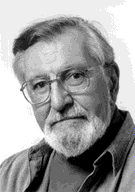
 It’s been a rough week for electronic music — having lost Bebe Barron, we’ve now lost one of the other great early pioneers of electronic music, South Australian Tristram Cary.
Tristram is credited by some as the father of tape music, originating tape music techniques in World War II. He’s notorious to the general public and sci fi fans as the composer of the music for the Daleks in Doctor Who (along with other music) — like an evil counterpart to Delia Derbyshire, who built the studio Cary would later use. But he was also a pivotal composer of music for film, electronics, voice, and instrument alike, a well-known Australian music critic, a leading figure in studios and academies, and, oh, yeah, he did the visual design (product design, really) for the legendary portable VCS3 "Putney" synth from EMS, the synth maker of which he was a founding Director.
It’s safe to say that, out of this web of contributions to electronic sound, Tristram Cary is another of those people who charted the course for what music technology is today. From the technology to his extensive music to his work in popularizing musique concrete in England, his impact is felt even by those who don’t know his name.
Christian Haines writes to let us know of Tristram passing, evidently following a long illness.
If you don’t know his work, there’s no time like the present to discover what he’s given us.
Wikipedia article, with lots of references and an extensive composition list
Resources at the Australian Music Centre
EMS, the "Moog Music of England", lives on (apologies to our UK readers, but Americans are just discovering EMS); see also the Synthi blog
And for a little Tristram Cary listening:
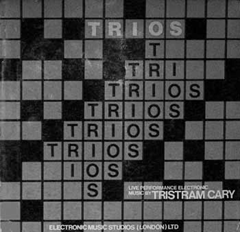
Trios LP by Tristram Cary (EMS) is a trio of EMS synth plus turntables; full tracks on the Synthi blog courtesy the composer. Really brilliant sounds:
And, you know, looking at all of this I’m reminded of why things like the Dalek connection are important. For whatever reason, mysterious science fiction worlds have been the entry point for listeners around the world into the sometimes alien and frightening new timbres of electronic music. We’re all lucky enough to have grown up in a time in which we’re challenged to create music that evokes other parts of the universe, real and imaginary.

Christian sends along a complete obituary provided by the Director of the Elder Conservatorium, David Lockett:
Tristram was born in Oxford on 14th May 1925. He served in the Royal Navy from 1943-6, specialising in radar and thereby receiving training in electronics. During his war service he independently developed the idea of what was to become tape music, and began experimenting as soon as he was released from the Navy in late 1946. From 1954 he found himself able to live by score commissions, and from that time produced a large variety of concert works and scores for theatre, radio, film, TV, public exhibitions etc.
He was founder (in 1967) of the electronic music studio at the Royal College of Music, and designed and built his own electronic music facility, one of the longest established private studios in the world. The equipment from this studio was brought to Australia, and most of it was incorporated into the expanding teaching studio at the University of Adelaide. He was also a founder Director of EMS (London) Ltd, and co-designer of the VCS3 (Putney) Synthesiser and other EMS products. He called upon a wide range of resources for generating film, TV, theatre, radio or concert music, special dialogue treatments, or anything in the area of specialised sound. His wide experience as a composer included all aspects of instrumental and vocal ensemble, any facet of electronic music, or combinations of several types.
Tristram played a pivotal role within the Elder Conservatorium until 1986, when he left the University to resume self-employment. During 1988-90, he was largely occupied with writing a major book on music technology which was published in London as The Illustrated Compendium of Musical Technology in May 1992 (Faber & Faber). The American version – substituting Dictionary for Compendium – is distributed by Greenwood Press, Connecticut.
In 1995 and 96 there were performances in London and Adelaide to mark his 70th birthday, and a new suite based on his music for the Ealing film The Ladykillers won The Gramophone Award for best film music CD in 1998.
Apart from composition activity, Tristram was a respected music critic for The Australian newspaper. In recent years he held the position of Honorary Visiting Research Fellow at the University of Adelaide, in which capacity he continued his computer music research. In 2001 the University also conferred on him the degree of Doctor of Music. In 1991 he was awarded the Medal of the Order of Australia (OAM) for services to Australian music. In 1999 he received the SA Great Music Award for the year, and Symphony Australia commissioned a new work – Scenes from a Life – to mark his 75th birthday in 2000. He received the Adelaide Critics Circle 2005 Lifetime Achievement Award on December 5, 2005.
His "The Illustrated Compendium of Music Technology" is well-worth seeking out. It's an absolute treasure, as were his contributions to our world.
[…] see CDM and Califaudio. This post will remain on top for the rest of the day out of respect. New posts if […]
[…] Matrixsynth and Create Digital Music for Tristram Cary […]
[…] Tristram Cary, Tape Music Pioneer, VCS3 Designer, Composer, Dies – Tristram is credited by some as the father of tape music, originating tape music techniques in […]
[…] The legendary and strange Radiophonic Workshop would have been 50 this month. The Beeb has a great little history article with video up. A vital piece of the DNA of Doctor Who and Pink Floyd was lost this month, now that Tristram Cary – VCS3 designer and Dalek theme music composer – has passed. More info on Create Digital Music. […]
[…] Create Digital Music reports, Tristram Cary died this week. Here’s the first third of the wonderful Australian […]
[…] UK electronic music scene lost its pioneer Tristram Cary this week, so it’s the perfect time to look back again at the marvels of the BBC Radiophonic […]
[…] 67 – A Radiophonic collage’ and was a snapshot in sound of the Montreal worlds fair in 1967. Tristram Cary composed music for the Great Britain pavilion and much of this is used in the programme. If you […]
[…] UK electronic music scene lost its pioneer Tristram Cary this week, so it’s the perfect time to look back again at the marvels of the BBC Radiophonic […]
I am absolutely saddened by this news; especially after spending a wonderful week in Asheville at EtherMusicFest08 (24-27 April) where Xenovibes presented two workshops and delivered the finale show to close the festival; all in honor of another great, Bob Moog.
The irony is that Tristram Cary was my 'teacher' of electronic music at the Elder Conservatory in Adelaide Australia…. way back when I was hungry to learn and with a mind young enough to mold. Mr Cary demanded the study of pure physics for many months as the initial rites.
I would like to get in touch with other students of Mr Cary to perhaps put on a concert in his memory. Please get in touch with me at shuehli@xenovibes.com if you are interested. Shueh-li Ong
I am greatly saddened at the news of Tristram Cary's passing. He was a dear friend and a greatly admired colleague. I was one of the first Americans to acquire a Putney VCS-3, and I had the pleasure of performing a commissioned piece I wrote for it with the Chicago Symphony in 1972, long before I met Tristram during a Senior Fulbright Scholar concert-and-lecture year in Australia and New Zealand. Tristram hosted me in Adelaide three times on various tours, introduced me to the best Australian wines, and was extraordinarily helpful and generous with his time. His wife Jane was equally generous with her hospitality.
When I was the founding director of the Electronic Music Studio at San Diego State University, we performed Tristram's TRIOS live, and I also did a great deal of his piano music.
He had a standing invitation to visit and lecture in San Diego, then later at Indiana University-Bloomington where I teach now, but somehow the time was never right. We did exchange CDs of new recordings and kept up a lively correspondence.
Tristram was also fond of anagrams, once producing 30 variants on my name. His favorite for himself was: "TARTY SIR MARC," as he occasionally signed things.
His passing leaves a great void professionally and personally, and I shall miss him terribly.
/ David Ward-Steinman
Adj. Prof. of Music, Indiana University
Distinguished Prof. Emeritus, San Diego State
University, California USA.
luogo grande, disegno piacevole….O
Onnea hyvasti!))