 Working on digital visuals for choreographer Grisha Coleman’s echo::system, I got to try some new techniques for running visuals. These were necessary experiments, so naturally we had some things that worked well, and some that didn’t. (For more on the piece, see the project site; warning: auto-playing audio via Flash!)
Two particular pieces of gear involved re-purposing lighting equipment for projection use. At the suggestion of video advisor Maya Ciarrocchi, we used Rosco iCue “intelligent mirrors” for positioning the projections. And because we had easy access to the equipment, we used color scrollers in place of dowsers for darkening projectors.
Now having spent some time with each piece of gear, and having gotten some mixed results, I’m happy to share my experience.
iCue “Intelligent Mirror”
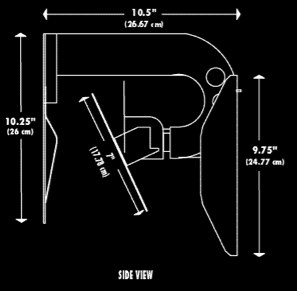
The iCue is a curious piece of hardware that receives DMX data (i.e., control data from a light board), and positions a mirror via a set of stepper motors. Using multiple DMX channels, you can send high-resolution DMX data, allowing for some fairly precise positioning. I say it’s a “curious” device in that it’s almost never actually used by lighting people, from what I could tell. Ot’s sort of a poor man’s movable light, and from a lighting perspective, if you can afford to just get a light that moves, that makes a lot more sense than using a somewhat temperamental moving mirror.
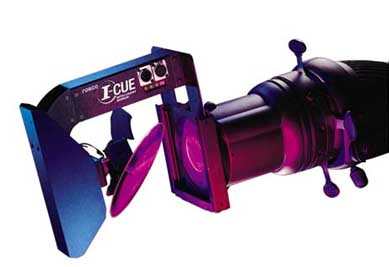
The iCue is used regularly by people doing projection, though, because it allows you to move projection images around freely. And I did find some elements of the design useful. The ability to move around an image opens up some very interesting possibilities, certainly. The round mirror on the iCue creates a naturally circular image that looks very nice. (More on that in a moment.) And the gear isn’t expensive; renting two for over two and a half weeks cost just over US$300. I expect you could find a deal on an unwanted iCue or two and throw it into a road case.
That’s the good news. We did immediately run into some issues with the iCue, however. First, the fact that you have to transmit DMX turns out to be a real pain. As a visualist, you ideally want control over everything you’re doing; you have enough problem working with a lighting designer just to keep your projections visible, without having to worry about using their light board to control gear you need. There are various MIDI-to-DMX converters out there, which could be a reasonable solution, but even then, I’d prefer to use MIDI directly. (If you’ve never used DMX, to a MIDI guru it can actually feel like a step backward — and most of us find MIDI plenty primitive on its own!)
And that’s before we started having DMX troubles. Apparently because of some strange interaction between one of our iCues and our lighting board, the iCue would sometimes behave erratically or stop responding. (We’re fairly certain this wasn’t the result of something as simple as a bad cable, because a second iCue daisy-chained through the first worked just fine.)
The other problem is the mirror itself. They’re extremely fragile; they routinely break in shipment. That’s presumably a problem with any mirror, but worth watching out for. The other issue is the default mirror is built for a light, so it’s round; you might need to build your own mirror for your own use.
Collectively, I have to say the drawbacks for me outweigh the advantages. The simple reality is that moving around a projection image isn’t something you’re all that likely to do in the first place. Moving the image is awkward, and it’s tough to choreograph movements so they look right. (Distortion isn’t such an issue — I quite liked some of the effects of that. But most of the time you might just achieve this with a stationary mirror.) I have to wonder if a better solution, if you really want this, would be to build a MIDI-controlled DIY mirror that you could design to your own specs. Controlling stepper motors isn’t such a big deal.
That said, the solution did essentially work; I’d just want MIDI-to-DMX control to go with it if I used it again, and I would tend to look for simpler solutions.
Color Scrollers
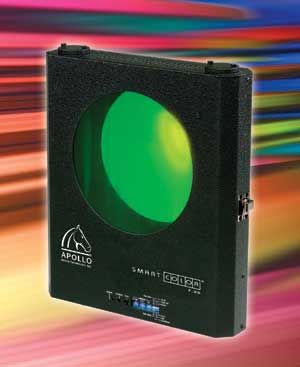 The other piece of lighting gear I got to work with was color scrollers. (Can’t recall the make/model of the ones we had, but they’re fairly standard.) These are rectangular boxes that are fitted in front of lights to change color, as the name implies. Inside is a roll of colored gel with gradated areas of color; the scroller simply scrolls the gel in front of the light to shift its color. Different gel scrolls are available for different effects; in our case, we had stepped color from light to dark.
In a pinch, the color scrollers certainly worked as dowsers: we were able to entirely block the light out of the projector, so we could blacken projectors when we needed. The problem is, there’s no particular advantage to using the color scroller in place of the dowser. The one thing a scroller can do is “fade” from one color to another, but it does so inelegantly enough that you’re unlikely ever to do that anyway. The effect isn’t so much a smooth fade as a series of stepped shades that scroll in front of the projector/light — that is, you get exactly what the scroller is. Working with projections, you’re far more likely to want to fade in and out with your source. Worst of all, the color scrollers are loud: they snap, crackle, and pop as they’re moved. With properly-maintained gels and the right unit, this might not be the case — I see various products employ the brand name “Whisper”, whether they live up to that or not. But they were certainly loud enough to be noticeable in our case, regardless of how carefully we moved them.
And, lastly, you’re back to using DMX yet again, which means navigating the needs of the lighting design on the board. A better solution is to use a dowser with a wired remote, so the projectionist/visualist can dowse manually.
That said, I wouldn’t be all negative on the color scroller. By going directly from light to dark and avoiding the intermediate gradations, we were easily able to make the scrollers into dowsers. And I have to return to the reason we used them in the first place: they were free. That’s a situation I could imagine happening again, because unlike iCues, color scrollers are very common in lighting.
Hands-on Experience?
So, there you have it: color scrollers and iCues are fascinating pieces of gear that … I … may never use again. But on the other hand, I can see cases in which I might have use for one, or have access to one and make use of it, and having had these frustrations with them actually would leave me better prepared for dealing with them in the future.
Given my complaints, was it worth it? Absolutely. Thinking out of the box and blending lighting techniques with projection offers the chance to do things differently, and, sometimes, at least, better. While I tended to learn the hard way, I learned a lot. And I see some real potential for new DIY solution, experiments with gels, and experiments with mixing light colored lighting with projection.
But I’m curious, have any of you had experience with these or related pieces of equipment? And anyone got a preferred way of generating DMX signal?
I am totally spoiled for DMX controllers, doing both lighting and video at the club where I work. That said, I use lightjockey for our DMX, it runs on a laptop easily and the software is free, but the dongle to make it talk to DMX runs about a grand. So, if you happen to be in a position where you're in a club that already has that in place, it should be relatively cake to drop something like this in the extant chain. Alternately, I know a guy who rents his dongle (*giggle*) locally, it seems likely that would be the case elsewhere. I find lightjockey totally intuitive, but, then again, I find vvvv totally intuitive, so YMMV. For me, if I was already shelling out to rent the iCues, an lj dongle rental would be completely worth it for the ease of control.
I'm very interested in all this DMX and lighting gear. While touring around quite a few of the VJish people I met had got into the field through stage lighting, whereas I don't have the first idea about lighting setups and DMX. My band did a performance on Australian Idol a couple of weeks ago, and their visual guy has all the projections, LED columns and lighting running from a massive DMX control surface. He said that their LED columns (which split the main screen video into about 10 different vertical columns) use up several thousand DMX channels, whatever that means.
Back down to the normal-VJ level, I know that Resolume can be controlled through DMX, so there's definitely crossover happening.
@panopticon — hey, thanks for that, interesting to hear how that's working for you.
I don't mean to trash DMX; it's usable, and does what it does. One issue we ran into is that you can't necessarily rely on the lighting boards you encounter to perform as you need, especially those that are set up for very simple theatrical applications. But even with a self-contained DMX setup, because of the extra gear required, I think you'd need to have a really good reason for using it.
I guess the other question here is how independent projection is from lighting from the design perspective. There's not a right or wrong answer to that. Obviously, it'll grow out of whatever design you have.
The other issue here was variable reliability / performance on these pieces of gear, which we had heard from others — namely, flakiness on the iCues, and inherent noise / awkwardness on the scrollers. Those I would still keep in mind as a caution.
But, yeah, I might have to go pick up one of those dongles. DMX could be very useful for dowsers, if nothing else.
check VMS and artificial eye's thrill software… the VMS units are like iCues but designed for video, and the thrill software controls them natively (under the hood there's a usb-dmx dongle and max/msp). they've been running this for most of this year at their own nights and corporate gigs round istanbul.
http://www.vms-at.com/product/productVMU.html http://ww.artificialeyes.tv/
having some experience with dmx i suggest you to have a look at VVVV http://vvvv.org
see my userpage to get an idea about dmx-related projects i did with vvvv.
its my favourite tool not only for controlling dmx. it also sends/receives midi and allows you to make your custom midi/dmx translation.
regarding that "strange interaction between one of your iCues and your lighting board" i want to ask if you terminated the end of the dmx-bus. for me this sounds like some kind of data reflection which might happen if the bus is not properly terminated.
you may contact me via vvvv's forum. my nick there is kalle.
Kalle, software wasn't an issue — just that I didn't have hardware capable of transmitting DMX. But then, I guess that was the main issue: we added an extra layer of complexity we didn't really need, and it left me relying on the lighting designer rather than being self-sufficient. In this case, the lighting designer told me outright he didn't know what he was doing with the board or DMX in general, so I had to liaison between him, various crew members, etc. So, yeah, if I did this again, I would need the extra hardware — but I'd also want to evaluate whether I really needed to do this in the first place.
vvvv's DMX stuff is very nice; I see there's lots of info on its wiki. I was using Java/Processing in this case, but it's just serial data — someone has already tried DMX output.
Well, Peter, for what i understood you asked for a "preferred way of generating DMX signal". Almost every lighting desk is designed especially for the needs either in theaters or live stages.
That means that you have to think everything in "cues" and "crossfades".
So programming these for generative needs is a real pain…
BTW: The cheapest dmx-interface available in europe i know is about 70 Euros but i only can recommend this if you use maximum 100 dmx channels. For 150-200 Euros you get pretty fast Interfaces.
Greetings all
I am also using a hacked I-cue with projection and am quite happy with it –
for folks interested in DMX you might also look into the LANbox products – depending on what product you get you can send it DMX, MIDI, USB, ethernet as well as digital and analog sensor data – it's pretty sweet – it also comes with a piece of free (download-able) software which functions as a light desk on your laptop…
It also has preprogrammed objects for connecting directly to both the Max/MSP/Jitter world (which I am using) and to Isadora (which I have used and would recommend highly – the learning cure is no where near as steep as with jitter…)
my main issue with the I-cue has to do with the difference between the x and y range and the transation between the 'Cartesian' world of my 2d desktop and the quasi 3d/polar world of the I-cue – I am finding moving video in a straight line to be quite a pain in the back side…
but between the I-cue and the Lanbox there has been no issues at all…
[…] I talked a bit last month about my woes trying to use a Rosco iCue “intelligent mirror.” The short version: skip the lighting board and the lighting op / designer, and do what Jamie Jewett suggests here, via comments: I am also using a hacked I-cue with projection and am quite happy with it – […]
[…] of my list of possibilities. In the end we didn’t have the cash to invest in VMS, but taking Peter’s previously tried route of mating an inexpensive Rosco iCue robotic mirror with the projectors we already had in our rig […]