Cakewalk’s been busy: a free update to SONAR with 64-bit audio and 64-bit CPU support for VST plug-ins, among other features, and plenty of other goodness from Messe. And yes, you’ll be running 64-bit VST plug-ins — and/or taking advantage of your 64-bit CPU and Windows OS — on Cakewalk’s DAW before Steinberg’s. Details after the jump.
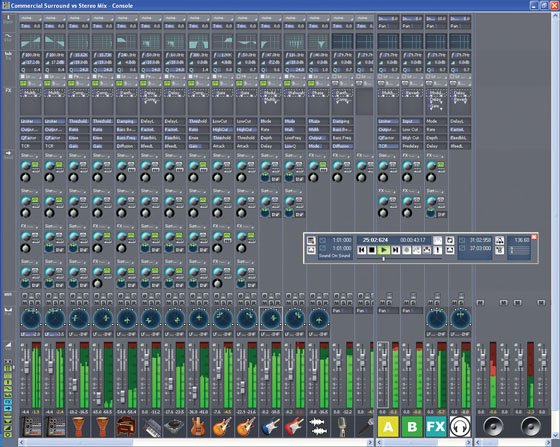
First, the (relatively) big news: Cakewalk announced they’ll release a free update to their flagship DAW in April. SONAR 5.2’s big innovation is that it’ll be the first DAW to support VST 2.4, even beating Steinberg’s own Cubase and Nuendo. That’s important for really one reason: VST 2.4 is totally 64-bit. The new SONAR will support 64-bit double-precision audio through VST effects and instruments, and support for 64-bit CPUs for compatibility with Windows XP Professional x64 Edition. (Damn, I hate Microsoft product names, but you get the picture.)
Note, as always, that these are separate issues: you can get audio on any machine, even with a 32-bit CPU and OS, but you only get the full benefits of 64-bit computing when you combine your 64-bit PC with the 64-bit version of Windows. Even in the most bleeding-edge PC circles, there just aren’t many people running x64. This could change that for audio, without a doubt. And while I heard grumblings at AES from competitors that they weren’t sure 64-bit audio was really important to audio quality, the release of SONAR 5.2 should help answer the question. We’ll actually get to play with new VST 2.4 effects and even soft synths (drooling especially at the latter), and find out just how good they sound.
Cakewalk is giving Mac users love, too, with Intel-native versions of their Dimension Pro and Rapture soft synths. I think these guys deserve some credit for tackling x64 on Windows and Intel on Mac at the same time. (And, incidentally, NO, they’re not remotely the same issue, say developers. Regardless of how well you know Intel chips, you have to deal with Apple’s development tools to make the Mac-Intel software work.)
You can check out more tidbits on Cakewalk’s Messe blog, including which US writers and magazines bothered to make the trip to Frankfurt just a couple of months after the exhausting NAMM show. (Thanks, I’ll pass.)
Most interesting among these:
To me, though, the bottom-line story is x64. I think this will ultimately impact a broader swath of users than even 64-bit double-float audio quality. The CPU side means that, if you have one of these fabulous new 64-bit CPUs in your PC, you can now confidently make the switch to Windows x64 and take advantage of the results, with a lot of supported hardware not only from Edirol (who are doing cross-promotion with Cakewalk, Intel, and Microsoft), but other vendors like M-Audio, too. Check out your local driver page and see if you can do it, keeping in mind you could always dual-boot the OS if you aren’t ready to completely switch over.
For bleeding-edge Windows fans, we’ll certainly be following this story over the coming weeks. In the meantime, anyone out there already running x64 and want to talk about it? Drop us a line.
looking at the situation on linux, where support for x86_64 has existed for rather a long time, there is a different viewpoint. while almost all linux audio apps will run on x86_64, using the platform creates significant pains for users. chief among them: plugins for lots of different applications (not just audio) cannot be used unless recompiled for x86_64. there is no flash/shockwave support for x86_64, for example. so you end up with a nice machine on which basic computing functionality ends up being less friendly. i don't think that this is going to be very different on windows for quite a while.
finally, x86_64 has almost nothing to do with 64 bit audio. the latter is handled by the FPU and not the CPU and is actually 80 bits wide, not 64, which tends to hide some of the largest benefits of the bus changes that surround x86_64 (not all, though).
we've had people using ardour on dual x86_64 AMD processors in 64 bit mode for more than a year now, and the benefits of x86_64 specifically (as opposed to AMD's superior architecture overall) are hard to see.
That's interesting. I have to admit, I need to test these further. Cakewalk claims some significant performance boosts in 64-bit processing . . . there are some differences between Intel and AMD, I know, and most of Cakewalk's marketing is around Intel, but that should theoretically be good for both.
And yes, there's a LOT of confusion around 64-bit audio versus 64-bit computing . . . particularly as you have Cakewalk trying to advocate both. We should use a different name, like double-precision audio or something.
But that's very disappointing to hear. I'll certainly try to find out more about the Windows situation. And I'm curious to try this out on Linux.
It would be cool to install Cakewalk Sonar in a VMWare Windows guest inside Linux. Cool 🙂
It would not be that cool. The CPU overhead would be almost as bad as the latency. I would file this under a solution in search of a problem.
how to renew nc cna certification
facebook proxy
how does a girl masterbate
buick wagon for sale craigslist
fotos ninel conde playboy
nicole austin butt naked
american pageant 12 edition answers
essay outline template
coco austin pictures
download chibi bleach characters mugen
penelope menchaca cojiendo
padosan aunty ki chudai
zoey deshanel not special
carta de renuncia voluntaria colombia
silpadacatalogue online com
madness interactive ninja mod
tridelta industries
karrine talks about lil wayne
jamiee foxworth pictures as crave
sexo con jaquelin arroyo