You need to find a specific sound quick, without hunting through individual plug-ins one at a time. You want to set up some layers and splits so you can play multiple sounds at once, then switch sounds at certain times in your set or during the song structure. You’ve got the instruments you want to play perfectly configured on your Windows PC tower in the studio, and want to move them over to a Mac laptop. All these tasks should be easy — but, for a variety of technical reasons, if you’re using two or more plug-ins, they’re not. At least, they’re not easy now.
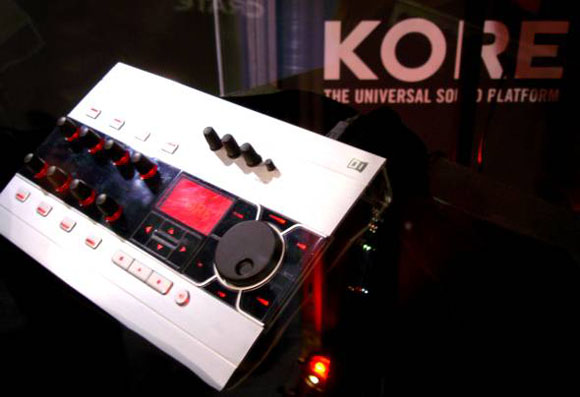
Trying to understand what Native Instruments KORE is in technical terms gets confusing: it’s a host . . . it’s a plug-in . . . it’s an editor/librarian . . . it’s a hardware control surface. But talk about the problems Native is trying to solve, and it makes perfect sense. If you love soft synths and plug-ins, once you see the feature list, you’ll be immediately intrigued. And if not, KORE wants to be the tool that convinces you to try playing software, onstage and in the studio.
Okay, so, really, what is it? Basically, KORE is a simplified host for managing your software instruments in a consistent interface. It’ll work really well with NI plug-ins, because Native has tagged, categorized, and configured all their sound content, but NI is hoping you’ll use third-party plug-ins, too. And they’re hoping you’ll be so enthusiastic about it, that other plug-in developers will follow and write keywords and meta-data for their patches for easier integration. Some plug-ins developers I talked to knew this was coming, but few knew details, and many found out about KORE at the same time as the rest of us. I expect we’ll know more details over the coming months.
“Just a host” doesn’t really cover it, though; it’s what it does and how that makes KORE unique. I got to talk to the NI engineers at NAMM, and here’s basically what they’re trying to do as I understand it:
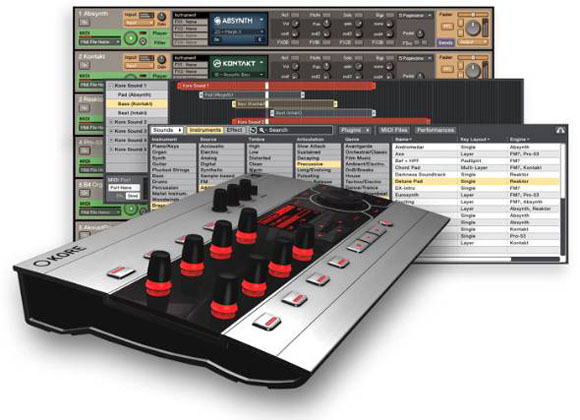
Preset management: Normally, to find a preset in an instrument, you have to first find the right plug-in, then navigate its (often non-standard) preset management settings to find the sound you want. With sounds that are pre-categorized (like NI’s) or that you’ve categorized yourself, KORE enables you to simply type in a keyword or patch name or other characteristic and immediately pull up the right sound, regardless of plug-in. For newcomers, this means fast and easy access to the right piano sound. For advanced users, it means you can get right at one of your zillion custom Reaktor patches. And for long-time MIDI studio enthusiasts, it means the days of the universal librarian may finally be back — only much-improved. This is the feature that’s earned the most skepticism, because for now it seems it’ll be most useful for NI plugs, but the folks at Native really do hope this will become a universal standard, especially in the absence of any near alternative. I hope so, too. (Presumably, though, you’ll still be able to search third-party presets by name.)
Control: In addition to knowing about what presets you’ve got in a synth, KORE also stores information about how you want to control parameters. NI is most enthusiastic about its 8-knob KORE hardware, which sends proprietary information over USB2 for four times the resolution of a MIDI knob. The implementation is slick: touch a bottom on the beautiful, slim hardware and the parameter name appears automatically, so you know your filter cutoff from your oscillator tuning. I think the idea behind the 8 knob interface is to provide at least one simple, basic standard for the most commonly-used sound controls, as Native did with their Xpress keyboard line. I didn’t get a chance to look at MIDI assignments, but obviously some of us will want control beyond 8 knobs, so we’ll do that with our existing MIDI controllers as before.
Playability: Since it’s an integrated environment for all your instruments, KORE naturally lets you configure splits and layers for playing multiple instruments at once. We’ve seen that before in hosts (though never a dedicated host that works on both Mac and Windows). What’s new is that you’ll also be able to easily switch between sound sets manually or automatically as part of your song structure. So if you want to take an organ solo over a bridge, you won’t have to mute and unmute channels on a mixer or switch MIDI channels or perform other counterintuitive tricks.
Sync: One detail I don’t think anyone else asked about: you’ll be able to use OSC to sync multiple computers running KORE, especially useful for those performance settings. Reaktor users have already been doing this with their setups for some time, but with KORE, it could appeal to a wider audience. More on this once it’s official.
Portability: Because KORE will store all this patch information and performance and control settings, you’ll be able to take your whole KORE setup anywhere you want — move from Logic to Live, SONAR to Fruity Loops, from your Mac to your PC, from your studio tower to your stage laptop, whatever. Of course, you’ll have to have the same plug-ins on both systems, but at least you won’t have to manually move over plug-ins. As someone with two computers who uses way too many hosts (let’s see, Max/MSP, SONAR, Live, and Logic on a regular basis), I’m interested to try this out. The only thing that makes me sad is that not all soft synths are plug-ins — like my Live and Logic instruments. So KORE will only benefit instruments that are plug-ins, not the ones that are integrated into the host.
Compatibility: Particularly on the Mac, juggling plug-in formats is a pain. KORE will work with all your VST and Audio Unit plug-ins (and possibly other formats), in any host. (Or so Native claims; obviously trying to break it will be one of our first jobs when we get the initial release!) No word yet on DirectX or RTAS, but Native didn’t provide specs and the product is still being developed, so this could change.
Audio: Weirdly, the KORE also includes an audio interface via USB2 and foot pedal jack. It seems like absolutely everything we buy now includes an audio interface. I expect we’ll soon see 2-in / 2-out audio interfaces included free with our box of Frosted Flakes. Anyway, we’ll know more about this once we see specs.
Compatibility: Mac/PC, VST, AU (at least to begin with)
Availability: Spring
Pricing: TBA
Everyone on the show floor I talked to was excited by all this, but wanted to know just how well it would work when managing third-party plug-ins. For now, we’ll have to be patient and wait for the finished product to answer this and many other questions. In the meantime, though, I’m thrilled by the concept. If they pull it off, I don’t think it’s hyperbolic for Native to claim that this will “revolutionize how performers and producers work.” Instant, playable access to soft synths would sure change my life.
Looks to me like this is the sort of thing that turns a computer-based set-up into a powerful tactile instrument. I think that KORE will revolutionize how performers and producers work. What I've really been looking for is a universal sound format that shifts the focus from individual instruments toward the sound itself.
Yes, Tom, PR-speak glosses over details, because that's its job. So let's avaluate this:
"powerful tactile instrument": This is indeed overstatement, because your keyboard or other MIDI input remains the major tactile instrument. The eight knobs will be useful for sound editing, and high-res is great, but there are lots of keyboards with control surfaces (more introduced this week). Anyway, I'll reserve judgment until I see how it does MIDI assignments.
"revolutionize how [people] work": Press releases say "revolutionize"; I'd just say "change." (That's why I don't work in PR.) But chance how performers and producers work? Absolutely. Perform different instruments in ANY host with the same split/layer configuration and ability to switch sounds in the middle of a song easily? Easily find sounds in the middle of production? That shouldn't be revolutionary, but it is, because there's no one, easy way to do this. Overdue? Yes. Revolutionary? Sure, if it works.
"Universal sound format" — yes, this is statement of fact. NI has created a new format for tagging and cataloging patches.
"Shift the focus from individual instruments toward the sound itself" — this is also true, not PR speak. As opposed to opening the preset settings in my TimewARP, then in my sampler, I could, for instance, see both those patches from one interface. Again, overdue? A decade into the plug-in thing, yes, I'd say so. But very big news. Editor/librarians changed the way I worked . . . until they weren't supported any more and I was suddenly using mostly software. I think this could change my work again.
Peter
The idea of a universal plug-in librarian with a standardized interface is long overdue. A couple of things concern me, though:
1. Third party developers will have to do additional work to provide metadata and mappings for this closed system.
2. The hardware is completely unnecessary and will simply increase cost — the software does the standardization, so the real power would be in supporting other control surfaces. That would dramatically increase sales and ensure that KORE software becomes a standard. Most modern keyboards come with a smattering of knobs and sliders, and it would be silly not to be able to use them.
3. The box is snazzy looking, but only eight rotaries? C'mon!
Yeah, James, I share these concerns, too.
1. Yes — NI says they want to evangelize this, but it's a lot of work (it was for them), and that's a new area for them.
2. I'm also skeptical of the hardware, but I don't think it replaces MIDI controllers. I think the idea is, it becomes a hardware lowest common denominator. Then you put this next to your Novation or whatever. Hey, I don't think they added a mount for a mic stand, though — let's hope I'm wrong. As for cost, well, we have to see. I think it's hard to get people to see value with software-only packages, sadly, so it may be a good idea.
I think they said the hardware is optional. If they made it into a dongle for running the software, they would face the full force of my wrath. (But I don't think they did.)
3. Agreed, but see point 2. I'm perfectly happy putting some settings on the 8 rotaries, then having something else on pitch / mod / X-Y / the various faders on my keyboards, etc.
So, in other words, my main concerns remain the same: how do MIDI assignments work? What happens with third-party plugs (since that's a big stated goal of NI's)? And where am I going to put your nifty rotary box?
Stay tuned. 🙂
I'm doubtful that the preset metadata will take off if Kore is the only host that will support it.
Why would plugin developers bother to support a format that would only marginally benefit them and their customers but would greatly benefit NI? Does a strong NI benefit us all? Especially with a product tied to hardware, so will be limited in its adoption from the outset.
Unless NI makes it an open standard, I can't see it taking off on a large scale. But if they do open it up, they'll lose the advantage they have with Kore's only unique feature.
I suppose they could do what Muse does with its abridged VST standard for the Receptor. I could see that some developers might include this feature in special versions of the plugins and then charge an added premium for those versions.
I'm really, really skeptical of the librarian stuff. To me it may border on useless, simply because of the huge legacy of pre-existing stuff.
I don't think it'll be worthwhile going through the ~17,000 patches I have for 138 VSTi's and deciding whether each one is, say, "lead" or "bass".
I agree, foosnark, but meta-data aside, shouldn't you at least be able to search by patch name? One of the many questions I have to ask . . . but no, while I might tag new sounds and patches as I create them, I'm not going to re-tag everything I already have.
It's a circular problem: I think this could benefit developers other than NI, but only if they invest this huge amount of time they don't have . . .
But I'm at least as intrigued by the hosting features as the librarian features. I usually wind up spending more time configuring performance than I do looking for the right sound (though that may just be me). I mean, even to take the NI instruments as an example, it isn't so counterintuitive to look for the B4 sound in the B4 plug-in, etc. And, even without meta-data, if I'm just looking for Rhodes patches, I could type in the name. (As long as the patch isn't named something silly like Rodez, which some are.)
Unless I'm missing something and this thing will act as a stand-alone plug host (ala the Muse Receptor), this is merely one more hardware knob box with a gimmick.
And the editor/librarian features are utterly useless to musicians like myself who are more interested in pushing boundaries than comping backing tracks for the local bar band.
I mean, yeah, using it to save time looking for a Bass synth or a Rhodes sound has some merit if you're a gigging musician. But what do you do if all your sounds are things like "Collapsing Dwarf Nebula" or "Gravel Slowly Falling on a Tin Roof"?!? Any category I give those patches would be merely arbitrary, and wouldn't serve any purpose other than to limit my use of those sounds with pre-conceived notions.
Not for everyone, and certainly not for me… :zzz
— glitch.@#$%!
Now, wait, carry on sleeping (mmmm, sleeping . . . not a bad idea after being at NAMM), but I have to answer this.
You're right to suspect this ain't no Receptor. This is a control box + audio + software. NI is not getting into the business of making PCs. And while I'd love a Receptor, I can't afford one at the moment — or tow it onto the NYC Subway as easily as my laptop. So I'm not especially keen for NI to do what the Receptor already does. (Plus I'd need both a Receptor and my laptop just to run Live . . . erm, no thanks.)
Now, as for your second charge, why wouldn't you be able to use this with any style of music you want? Splits / layers / controller assignments apply to just about everyone. (I like to collapse dwarf nebulae with my left hand while playing imploding plasma layered with Klingon blood falling on a wet dog in my right, personally.) And I might then want to automatically switch to another sound without reading for a mouse. And since you can provide your own categories, if you're doing your own sound designs, there's no reason you can't make up your own system. That's certainly what I do already, and how I'd use this. No one else may want this particularly odd and unpredictable pad based on unhealthy modulation I've designed, but I can probably think of a category by which I can remember it. (In fact, if anything, that'd encourage me to sit down and finish more of my own patches.)
This will work with Reaktor instruments and (via Pluggo) should work with Max/MSP stuff, too. And there's computer to computer OSC sync. So for the weirdness factor, you're good to go. Otherwise someone as weird as me wouldn't be interested.
Still not saying it's for you, but my bet is this will appeal *more* to the hard core sound designer and plug-in addict than Joe Keyboard player, for whom this might be overkill.
Peter
Yeah, I did mention being able to create my own categories. When I said that, I was actually envisioning the way patches are broken down in Spectrasonics Atmosphere as a for instance. However, that tends to make you classify your patches (and, as well, your mental conception of your patches) before you've found a use for them. For instance, "Stretching Metal Beams" may well fit into my Disturbing Textures category, but what's to stop me from using that as the string chorus in the back of a soundtrack? Nothing. Would I have thought of that application if I had continued to pigeonhole that sound as merely a Disturbing Texture. Maybe not.
Ask yourself, in order to work efficiently, do you need to organize your sounds and set mental boundaries around what you're doing, or do you need to erase those boundaries and find out where that approach leads you. The answer to that question may very well tell you if such a Librarian is of any use.
As for splits and layers, can't you just do that within your host just as easily? I'll admit, I've been standardized on Live for the past couple of years (with an occasional foray into Rax). Splits/Layers have just never given me that much of a hassle.
Now one place where I could imagine the KORE's librarian might be more useful is with *effect* plug-ins. Where synth sounds are usually fairly contained to a single VST (or at least a few VST's that are pretty easy to pick apart — "hrm, was that Klingon Blood Falling on a Wet Dog layered over Imploding Plasma, or was that Slurping Cthuluean Saliva?") it's usually much harder to separate or even identify some effects when they're chained together, much less recreate a chain. In Live 5, you can now do this using the Audio Device Groups, but I'd see a use for it elsewhere (read: everywhere). "Uh oh, did I put KT Granulator before or after Augustus Loop on that patch…?"
Overall, I'd still place this merely in the "knob box" camp. Just like knob, sliders, buttons, joysticks, IR controllers, D-Beams, or any other interface tool, it's going to appeal to the way some people like to work. Other people would just as soon do everything with a mouse. And others still just won't care much about the whole argument in the first place.
As always, it comes down to the universal YMMV…
— glitch.@#$%!
I heard it would be $1700.
I can't see this thing costing $1700. I'm assuming you mean MSRP but even then that's more than Komplete 3. The hardware is a simple modification of the Rig Control 2 which, with software, has a street value of $500. Granted the hardware controls seem to be quite a bit more sophisticated but the audio components I would assume to be the same. As for the software I would think that the cost of development for GR2 would be greater than that of Kore. So back and forth, all things considered, I would estimate the price for Kore to be the same as GR2 if not cheaper. As a Komplete 3 owner I'm incredibly excited about this product but I won't pay more than $500 for it and doubt that I will have to.
Native didn't say ANYTHING about price. So anything you heard must've been something else. Maybe that Korg keyboard. You know — KORE, not Korg. 😉
Virgil's right . . . I expect price would be closer to $500 based on past experience. Well, almost right — I'll betcha KORE took more time than Guitar Rig to develop. But anyway, that's not how you price products; it's a marketing decision (and you think more about support costs than development costs, because that impacts your cost per user). I'm hoping for a very low price, because that will speed adoption, and the more broadly KORE gets adopted, the more successful the idea will be — and the more likely third party developers will be to develop for the "universal sound format." But I would be very surprised if it's over $500. And you can quote me on that, because no one at Native told me or anyone else anything, so you can be positive that this is entirely based on my uneducated instincts.
Peter