Gibson has been crowing about a digital Les Paul guitar for a long time. The first I remember reading about it was the breathless January 2004 article in Wired. Their proprietary tech for carrying audio over Ethernet was mysteriously called “Magic.” Sample quote: “Like Sony and Philips with the compact disc 20 years ago, Gibson is making a big bet on Magic, whose success hinges on nothing less than the reinvention of an entire industry.”
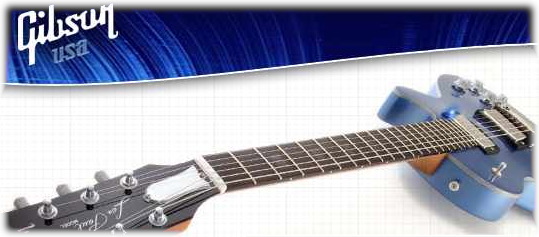
The success of the digital Les Paul has turned out not to dependent on reinventing anything, but on Gibson actually shipping the product. Friday at Digital Life Expo here in NYC, they at least provided hands-on experience. (See Gizmodo writeup; more on that in a second.) But the product still isn’t due to ship until early next year, and Gibson has delayed promised ship dates before.
The “Digital Guitar” probably isn’t quite what you think, either. The digital connection out of the guitar has to be converted back to analog before you can use it, because of the way Gibson designed the system . . .
Of course, there’s nothing terribly magical about converting analog pickups to digital form. Brian Moore Guitars, among other makers, have been doing this for some time. The ingredients are relatively simple: you have a hex pickup, one for each string, 13-pin RMC connectors which carry analog signal from each pickup, and a USB box like Roland’s GI-20 that converts to MIDI and digital audio for the computer. (The upcoming iGuitar.USB allows direct audio connections, but you’ll still need RMC to convert to MIDI — just in case you want to play that far-out soft synth by plucking, or transcribe a tune into a notation program.)
Here’s where things get a little odd: if Gibson is creating a “magical” connection from guitar to computer, you’d think you’d be able to directly connect the Ethernet cable. Wrong. You still need a breakout box. Not only that, but the breakout box does something kind of strange: it converts analog back to digital again. (See Gibson’s how it works.) The major advantage of this is that you have full control over each pickup and how it’s used. That’s pretty cool, and that’s why at Digital Life they showed off a test with the Digital Guitar and Cakewalk‘s SONAR with each string routed to a different surround speaker.
But what’s odd here is, you go to all this trouble of creating an “innovative” digital guitar — only to wind up with analog signals again at the end. That SONAR demo? They plugged the multiple analog channels back into an analog audio card on the computer. You’ve got no MIDI control, and no digital connection to the computer.
So what’s the point of the Digital Guitar? Underneath all the hype, is just comes down to audio transmission. You can run a connection from the Digital Guitar up to 200 meters — something you can’t do with an analog connection. And by putting the digital conversion on the guitar, that keeps the whole connection out of the guitar clean.
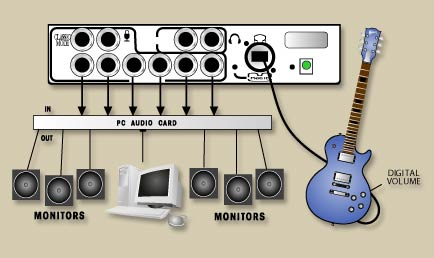
Not necessarily a bad thing, but I’ll bet it’s not what people imagine when they hear “Digital Guitar.” For most people, this system simply has no major advantages. Most people want a stereo-only configuration anyway, not some weird surround setup with different strings going to speakers. And you have the disadvantages of digital systems (a breakout box, which Gibson inexplicably calls BoB), with none of the normal advantages (digital recording, processing, and MIDI control.)
If MIDI control is what you want, or if you want a direct-digital connection to your computer, why not just buy a Brian Moore guitar instead? It’s shipping now, and you’ll find the price is less than buying a high-quality guitar and adding pickups yourself.
I’m not dismissing the Gibson yet; I just want more of a non-marketing-speak explanation of why it makes sense. Gibson is in town this week for Music Player Live, so hopefully I’ll be able to go direct to the source. Stay tuned.
See also:
FireWire Electric Guitar (no, I don’t know why it has no knobs)
iUke USB Ukulele: More Details, USB Guitar is Coming Soon
I've been using a Godin guitar with the RMC output for MIDI since 2002, so nothing new here. The intriguing aspect of the Gibson is the separate audio output for each string, but I know some company already makes a rackmount unit to extract from the RMC connection the separate outputs of each string (sorry, don't remember who). So, more boxes and wires, no new capability, at a premium Gibson price, maybe sometime next year. What a concept.
Why bother with a CAT 5 connection, with fragile, solid copper wires, when you can achieve similar results using a balanced cable?
Or, even better, go wireless. Good-quality UHF wireless guitar transmitters have been around since the 80's.
Aside from the electronics, the guitar looks like a low-end basic Les Paul Standard. You'd think they could gussy it up a bit, maybe produce something nicer looking, like a Custom. You know it's got to cost a bundle when they conspicuously avoid mentioning the price, but it looks like they're stuffing expensive electronics into a low end axe.
I wouldn't piss on this guitar if it was on fire. This project is part of the reason that OpCode ceased to exist. This is also the company that eviscerated Oberheim. Stay away.
I agree this seems like a confused and dubious achievement.
But I get kind of tired of Brian Moore always being mentioned as "The MIDI guitar". Don't forget Godin has been making great "Synth Access" guitars with Roland GK-compatible interfaces for a long time. The Godin guitars use the RMC, LR Baggs and most recently the excellent GraphTech Ghost piezo-bridges.
Check out the Godin Freeway SA or the XTsa. Both great instruments are under $1000.
As a note, I think the USB version of the Brian Moore iGuitar allows access to each audio channel from the hexaphonic pickup discreetly. But as with this Gibson I'm not sure why you would want that. The more general Roland system of converting each string to a MIDI channel is much more useful and works brilliantly with a Godin or a BM.13.
Fender also makes a Roland-GK-compatible version of the Strat. And there are handful of others.
These are finally available online.
Sweetwater has like 7 in stock.
3999 seems a bit pricey. I am sure
it will come down in a year or so.
The last guitar that I can remember
with a Hex Pickup and a Break Out Box
was the Gittler.
It has long been looking for this information, Thank you for your work.
Hm that sounds good but I would like to know more details.
Stunning blog and good article. High 5 for u man !