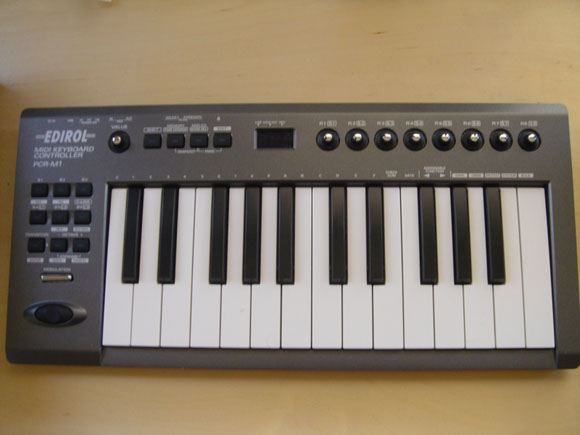
Backpack digital musicians seeking even more portability, the PCR-M1 remains the holy grail of thin keyboards. CDM’s own Lee Sherman gives Edirol’s keyboard-on-a-diet a pin to see if you’ll miss the extra inches and pounds. -PK
Musicians looking for a MIDI Keyboard Controller are spoilt for choice these days, with controllers for everyone from DJs and laptop musicians to classically trained concert pianists. So where does the PCR-M1 fit in?
Edirol, who has been in the controller game longer than most, have clearly aimed it at the computer musician who wants to slip this thing into a backpack along with a laptop and go. This is the same territory in fact, that M-Audio mapped out with its highly successful Oxygen 8. But the PCR-M1 goes the Oxygen 8 a few steps better. (read more)
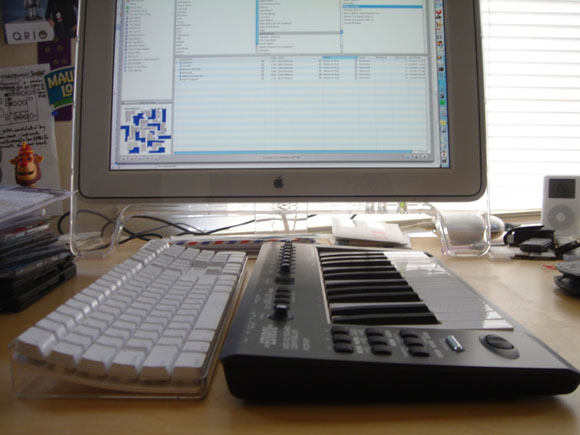
The S.L.I.M. Keyboard, first seen on the companies� PCR-1 is the most portable yet still playable keyboard on the market today. It measures a mere one inch thick and weighs just a bit over 2 lbs. If you don�t have room for this in your project studio, you should probably consider moving to a bigger place.
Like most controllers of this type, it includes 25-standard width keys. The short keys and shallow action are a necessary compromise but the keyboard feels solidly made, quite unlike the cheap-feeling keys found on too many other controllers. The charcoal gray exterior looks professional and helps work against the impression that something so small can�t seriously be considered a real musical instrument.
The controls include a single infinite rotary encoder that affects whatever parameter you have selected and eight assignable knobs that send MIDI values to their assigned destinations. The four buttons alongside the rotary encoder can be used to set MIDI channel, select banks, change programs, and other common operations. A simple three-character LED is available to indicate current values.
Nine additional buttons to the left of the keyboard perform functions such as octave shift, transpose, enter, back, cancel, and transport control functions. The button arrangement is logical, functional and complete. It�s difficult to imagine any hardware function or software parameter that couldn�t be controlled by this device.
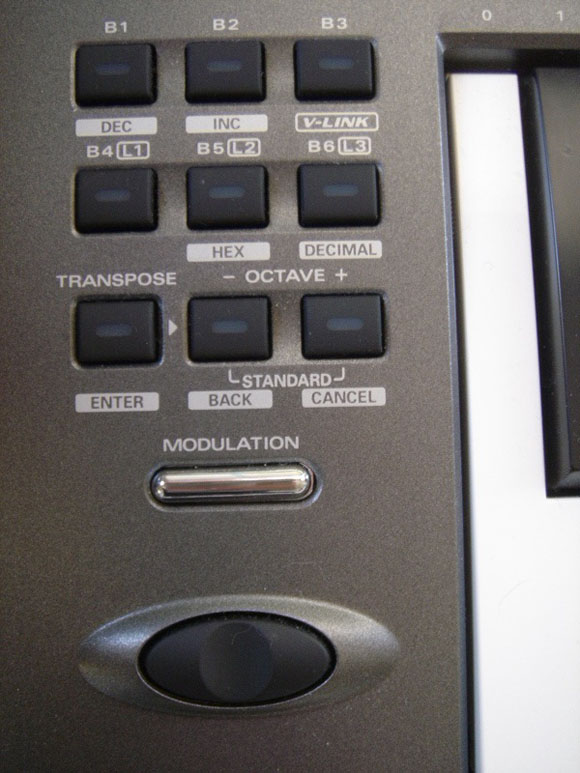
I was less impressed with the performance controls which are unlike any I�ve encountered. In place of the usual wheels or joystick are a short metal bar, used for modulation, and a rubberized oval-shaped pitch bend control. The PCR-M1 can be powered by the USB bus, four AAA batteries, or an optional AC-adapter, adding greatly to its portability.
Peering around the back, you�ll find MIDI In and Out, and jacks for connecting sustain and expression pedals. The VJs in the house will welcome the inclusion of a V-Link connector, allowing you to link your musical performances to video.
Other controllers these days, from the likes of Novation and M-Audio, come already set-up for use with leading software instruments, so I was a bit disappointed that I had to spend the time creating my own templates. Fortunately, this is made relatively easy with the inclusion of some plastic overlay templates and a software editor. The editor�s MIDI Learn function allows you to quickly map the hardware controls to software parameters.
I used the PCR-1 to control a variety of software instruments running on my Mac G5 in both standalone and plug-in mode and found it to be extremely responsive. I was pleasantly surprised by the keyboard feel but I never could get used to the mod and pitch bend controls. I found both to be awkward to use and wouldn�t want to be stuck with them for extended soloing.
Despite these minor reservations, the PCR-M1 remains a very good choice for DJs, VJs, and anyone who wants to add an extremely compact yet still playable and functional controller to their gig bag.
Seems to me that if you're going to highlight how slim this controller is (1.125" per Edirol's web site), you could pick a better comparison point than Oxygen8 (3.75" per M-Audio's web site). O2 is much slimmer (1.5" per M-Audio's web site) than Oxygen8. Of course, I haven't used an O2 (and in fact I don't actually "play" so much as laboriously enter snippets into the computer a hundred times until I don't hate the results) so I don't know how playable it is. In any case it might be an interesting follow-up review.
No, you're right, absolutely: the O2 is M-Audio's rival to the Edirol keyboard, and it's $50 cheaper. That's the good news; the bad news is, I think the keyboard is much better on the Edirol, and the PCR-M1 has continuous knobs, while the O2 does not. And, of course, you can get a version of the Edirol keyboard with audio interface included if you desire. Unfortunately, both have odd controllers in place of real pitch/mod wheels because of the space requirements. My money remains on Edirol in this category, though I'd still be up for spending some more time with the M-Audio keyboard to see if it changes my mind.
Because it was the first and most ubiquitous, the Oxygen 8 reigns supreme as a portable keyboard despite having a horrendous cheap-feeling action (in contrast to other M-Audio kit, much of which is superb — audio interfaces, the Trigger Finger and new large-size keyboards, for instance). So I would compare it: spend the extra $50 and get more portability if that's what you're after.
I do expect to have some Korg keyboards around here, too, so they can enter the ring.
Lee, what do you think?
Peter
Since we're on the subject of small-form-factor MIDI controllers, the MK is a good choice for live-performance. However, I wouldn't recommend it for studio work (even small-desktop work), due to the painfully hard-to-use keys. If you can belt out a decent solo on a casiotone, maybe you can do something with those thin-ass keys, but for most of us it's just not possible. The sliders are tops, as are the trigger pads and the joystick is an absolute dream. But, where it kind of disappoints is in the build-quality of the encoders. Since I got my MK a year and a half ago, 3 of the encoders have failed in such a way as they are useless for any fine-detail work, and the others may go at any time. I blame the heavy abuse I put on those encoders when I play live in my band or solo DJ, but still I would hope that the encoders would have lasted longer than they did.
The problem I have with many of these new controllers is the build-quality is really sub-standard and can't really take a beating like some of the older bits of gear can. This creates a problem for bands on stage, as it's hard to tell when in the tour the controllers are going to break down (and if it's a long one, they will).
In conclusion, the MicroKontrol is a mixed bag, as it’s killer for live performance and some small studio work (as long as you don’t plan on playing the keyboard), but the build-quality of the encoders is rather fragile, so please take care no to abuse them on stage or off.Don’t be like me, and burn out a $300 controller in less than 2 years.
ATA
That's too bad to hear about the quality issue; I've talked to other MicroKontrol owners who've been satisfied (and even more people regarding the MicroKorg, though the build quality may vary between those two).
As far as the size of the keys, of course, there's now the Kontrol 49 which has full-size keys and seems to be quite nice.
There's a MicroKontrol review here: http://www.em411.com/show/review/351/1/microkontr…
But I'm anxious to try the Kontrol 49.
Peter
Yes, kokorozashi makes a good point and, as a former Oxygen 8 owner, I would indeed like to see how the O2 stacks up. I wasn't so much trying to make a direct comparison as I was introducing the category (thinness, in itself doesn't, to my way of thinking, constitute a whole new category of keyboards in itself) . 2-octave MIDI controllers, now that's a category.
I was actually prepared to hate the PCR-1 because my first thought was that the thinness might turn out to be an unacceptable compromise. Afterall, the Oxygen 8 still slips into a backback with room to spare for a laptop and how much portability do you actually need? Playing the PCR-1 over an extended period of time is what changed my mind.
M-Audio, if you're listening, bring on the O2.
does the shallow action make it annoying to play and has it got weird velocity sensitive and if so how is it ? i bought a behringer uma25 and it feels so cheap and crap, the shallow action just gets annoying and the velocity is all over the place ….. i was thinking about getting this ? what do you think ?
Hi guys, from Chile seeking for your help…recently got a PCR-M1 only with a USB cable…¿what program can I use to Edit, taking on account that I have Windows 7 Home Basic and the only available edition en the web of PCREditor 1.00 only can run on Windows XP/Me/98/2000? Hope you can help me. Thanks