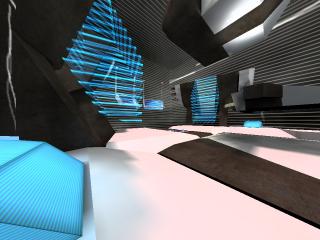
Gaming environments like Quake and Unreal have become easy interactive 3D development environments. Modify the game maps and objects, and you can make the visual realm in these games whatever you want. But for digital musicians imagining a 3D environment for creating music and sound, they’re limited.
Enter the latest project from fijuu2 creator Julian Oliver, together with Steven Pickles. They wanted powerful synthesis capabilities, which is something you’re unlikely ever to get in a game like Quake III. So, they found a way to send network data from Quake into the free software Pd, using Pd’s netsend object to send UDP packets containing control data from the game. In other words, instead of using a MIDI controller, you can make the game your control instrument. netsend is in Max/MSP, too, so this should work for Max, as well.
You’ll need two machines for this to work right, but the objects are freely available from Julian and Steven; follow the download link on the project page:
I’ve been following progress on Julian’s blog; it’s a good read. For more on the work, here’s our friend Chris at Pixelsumo:
. . . and to see it in action, Julian posts a video:
q3apd in gorgeous OGG video glory
For Pd fans, Steven has a goodie of his own: an abstraction that fakes poly~ from Max/MSP inside Pd, plus some other objects.
Given the ready availability of map editors and such (at least if you have access to Windows), I expect you’ll see more projects like this. We’ve seen work before, certainly, that creates art inside the game engines, but by linking to real synthesis libraries you can do more than just mix pre-rendered sound sources. Speaking of which, any other readers experimenting with game engines? Let us know. And feel free to share in our gaming forum.
there is a video on youtube too, for those who cant open ogg
http://www.youtube.com/watch?v=rlwGNtSv2g0
Thanks, Chris. Was looking for that and didn't find it. If you do want to open OGG, though, here's my favorite player:
http://www.videolan.org/
Windows, Mac, and Linux. I'm having trouble getting it to work on my SUSE build, but otherwise it's great! 😉
Tried to get this to work the other day, but Quake didn't seem to like my graphics card drivers on Linux. I'm going to install a newer distro and see what I can do.
Looks like a great idea — and really flexible, too.
Check your drivers . . . both ATI and NVidia require commercial drivers that are almost never included with your distro. Stick with your current distro, and look for the drivers. For instance, with NVidia usually the unaccelerated nv driver replaces the full nvidia driver. Googling will often help you get more detailed instructions.
Dling both vlc and video to see what this is….:D
How I love the digital world
Yeah, I've had all trouble with all that xorg.conf malarkey in the past. My box really was in need of a reinstall, though — I think it was running Slack 10.1, and I'd messed up various symlinks over the year or so I used it. It just felt dirty. 😀
Anyway, I installed Arch Linux 0.7.2 yesterday, and it seems to be working nicely, with the NVidia drivers and all. I'm just about to get Quake set up.
[…] It’s not hard to imagine a world in which customized game tools become simple 3D environments for producing truly original visuals — work that looks unrelated to the game engines that power it. The fact that 3D engines are designed for real-time operation makes them even more appealing for live visuals and VJ work. Artists like Julian Oliver have produced whole music and visual performance pieces, as we’ve seen on Create Digital Music. […]
[…] http://createdigitalmusic.com/2006/06/09/use-quake-iii-to-play-pd-maxmsp/ […]
[…] constantly finding ways of making three-dimensional, virtual spaces more expressive. We’ve seen Quake as a musical instrument, gaming actors as insane digital painters, and 3D interactive game equivalents of Grantz Graf. But […]